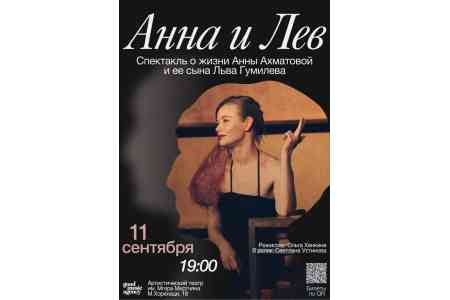
ArmInfo. On September 11, the Yerevan premiere of Olga Khenkina's one-woman show "Anna and Lev" will take place at the Mher Mkrtchyan Artistic Theater. This is a poignant story about the dialogue between the great poetess Anna Akhmatova and her son Lev Gumilyov that never took place - about the pain of misunderstanding, the desire to be heard by loved ones, regardless of the circumstances. The play is permeated with love, pain and hope, which turns into a confession and inevitably resonates in the hearts of the audience.
The roles of both Akhmatova and Gumilyov are played by the actress of the Chekhov Moscow Art Theater, the star of the TV series "Kept Women" and other projects - Svetlana Ustinova.
The premiere of the play took place in the USA, then it was presented to the public in Germany, France, Switzerland, Latvia, Estonia, Monaco. And tomorrow, the Yerevan audience will see it for the first time. It is noteworthy that is Khenkina's debut directorial work. Before this performance, she was known to the general public as a producer, screenwriter and casting director, having worked for many years at the Moscow Art Theater named after A.P. Chekhov.
In an interview with an ArmInfo correspondent, Olga Henikina spoke about how this performance was born, how difficult it was to decide to start directing, about her future plans and about the influence of Oleg Pavlovich Tabakov (1935-2018) - a great actor, director, teacher, theater figure, one of the founders of the Sovremennik Theater, artistic director of the Moscow Art Theater named after A. Chekhov, with whom she closely collaborated for many years.
- Olga, I know that is your first directorial work. How long did it take you to become a stage director? How often did you think about moving from producing to directing?
- I never thought about it. As they say, it was a coincidence. Svetlana Ustinova and I worked together at the Moscow Art Theatre, and later, after Sveta had shot her full-length film , the idea arose to write a script about the life of Anna Akhmatova.
We started working, reread and reviewed a lot of materials, interviews, letters and memoirs, and somehow it suddenly became clear that it should be a play. And when the text was finished, I didn't want to give it to anyone. That's how I became a director.
- Why was the theme of mother and son chosen? Was it some kind of personal story or was the choice of such a theme due to the complexity of the relationship that I wanted to work with?
You won't believe it, but the theme revealed itself. Reading the entire published archive of Akhmatova and her biographers, reviewing dozens of interviews with Lev Nikolaevich Gumilyov, we, without saying a word, realized that the drama of the relationship between mother and son came to the forefront and it was important to talk about it with the audience.
- I would like to know if the play is based on the original text of letters between Anna Akhmatova and her son, or the author's adaptation? Of course, all the quotes are unchanged. As for the direct speech of the characters, it is, of course, adapted.
And what was most important for you, as a director, in this production? What is the main message or question?
Rather questions in the plural. A great artist, whose works inspire generations, can combine creativity and motherhood, the adoration of fans and their own empathy? Do they share the suffering of their loved ones or live in their own illusory world?
All these questions have been asked for centuries, and we have been looking for answers to them for centuries.
Is there anything that became a discovery for you about Akhmatova and Gumilev while working on the play? Yes, we discovered many new details of their lives, sometimes completely unexpected, causing a desire to adjust new optics. And sometimes a desire to quickly forget these details and remain in ignorance:
Is there something in this work that the Yerevan viewer, in your opinion, should not miss?
I am absolutely sure that the Yerevan audience is one of the most tender and at the same time passionate audiences, feeling the nature of the theater down to the smallest nuances. So there is no need to prompt him, he will understand everything himself.
And what does this work mean to you personally?
Like all debutants, I love this performance very much, it is my firstborn.
I am also interested in your work with Svetlana Ustinova. How easy or, on the contrary, difficult was the joint creative process? Was the decision to have a one-woman show made initially, or did such an outcome arise in the process of work? Svetlana is an amazing actress, bold and daring, you can offer her any, the most unexpected scene solution and she will fulfill it. When we finished the play and read it to Sveta's family, it immediately became clear that both roles should be played by one actress. The experience of our tour showed that the decision was correct.
Please tell us in which cities this performance has already been seen, and in your opinion, is it intended for a specific audience, or can this topic affect everyone? The performance has been to America, Germany, France, Switzerland and Monaco. Of course, our audience is a Russian-speaking audience from thirty to one hundred years old, but we ourselves were shocked by how young people and teenagers received our performance. As one great theater figure said: "If it's not about me, then why watch it?" The greatest reward is when the audience comes up to us and says: "This is about me."
In that case, I can't help but ask you about your future plans - will we hear more about Olga Khenkina's directing work or was the play , so to speak, an experiment for you?
Yes, I got up my nerve and decided to continue my directing experiments. Now I'm working on a play about two brilliant women - Coco Chanel and Ida Rubinstein, a fashion designer and a dancer. A completely different genre and a different scope, but the theme of strong creative women remains. And finally, I would like to touch on your path with Oleg Pavlovich Tabakov. I know that you worked together for many years at the Chekhov Moscow Art Theatre. Can we say that your transition to directing was largely due to his influence? And is there anything that you consciously adopted from Oleg Pavlovich in your directing work?
Oleg Pavlovich, unlike me, never directed in a professional theatre, only with his students. He was sure that everyone should do their own thing. An actor should act, a painter should design and dress, a composer should write music, and a director should come up with a play. In his lifetime, I would not only not have decided to do directing, but I would not have even dared to think about it. But time goes by, the situation changes, someone suggests trying, and a crazy idea suddenly becomes reality. So I am a living example of the improbability of life's collisions.
Thank you for the interesting conversation and further success!










 Expert: Azerbaijan`s political leadership states `occupation of Armenia is their new national goal`
  Expert: Armenian society falls into security trap of totalitarianism
 Expert: Pashinyan`s visit to Russia creates prerequisites for restoring dialogue, but thaw in relations is more symbolic
 Human rights activist Ruben Melikyan dismissed from YSU
 Pashinyan removed from INNOPROM guest list
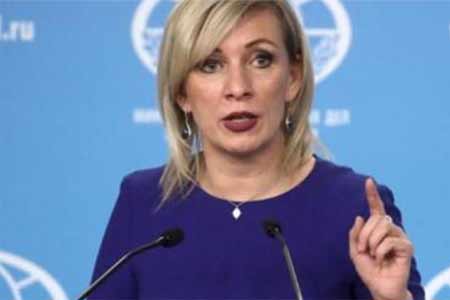 Zakharova: Armenia`s pro-EU pivot poses economic security risks to EAEU member states
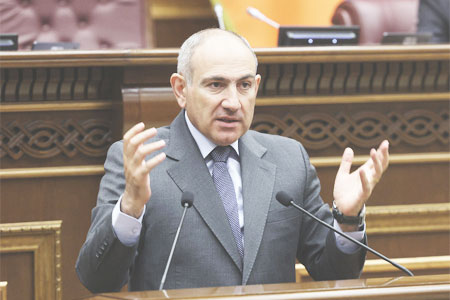 It`s time for South Caucasus countries to think of South Caucasus as single, unified region - RA premier
  Pashinyan: Armenia and Azerbaijan should leave each other alone
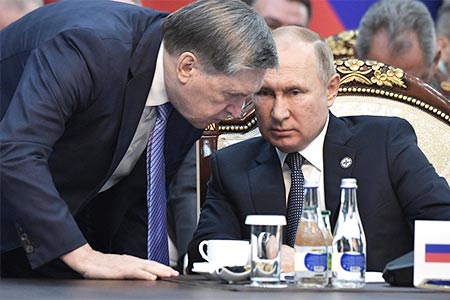 Moscow sees situation with Armenia as attempt to attack Russia-involving integration associations - Russian presidential aid
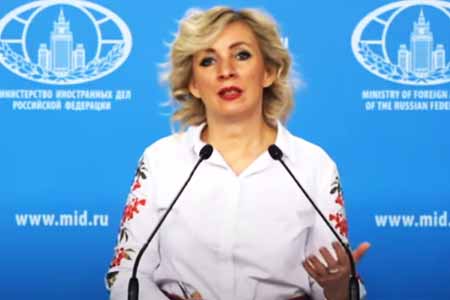 Zakharova: Armenia views relations with Russia as tool for financially securing reorientation toward EU
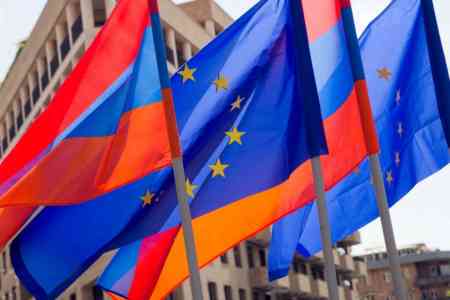 The Armenian Minister of Justice and the EU Ambassador discussed visa liberalization issues for Yerevan.
 Azerbaijan`s aggressive plans against Armenia became possible in wake of Pashinyan`s decisions on Artsakh - expert
 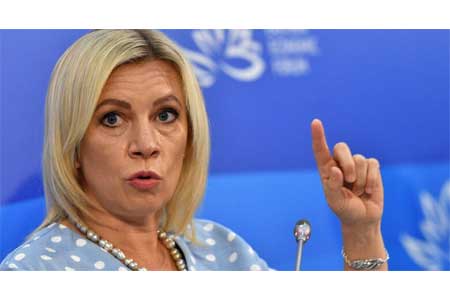 Zakharova: Russia sent a note of protest to Armenia over the act of vandalism at the "Mother Armenia" memorial in Gyumri
 Samvel Karapetyan proposes creating a post-election opposition coalition
 Artsakh`s Cultural Heritage Ombudsman called on Moscow to respond to destruction of WWII monuments by Azerbaijan in occupied NKR
 Prosecutor General`s Office petitions Central Electoral Commission for criminal prosecution of Robert Kocharyan
 Dutch Prime Minister expresses his support for Armenia`s democratic reform and economic diversification agenda
 Heritage: It`s time for Armenia`s opposition to present people with legitimate alternative to power