

ArmInfo. In a context where the Strait of Hormuz has become perceived as a platform for long-term strategic influence, Iran's goal is not to close the strait, but to become a participant in its security system such that, if its decisive role and interests are ignored, ensuring the safety of international shipping will become difficult. This is stated in an article by political analyst and Iran expert Aram Shahnazaryan, published by the press service of the Alternative Projects group.
In it, the political scientist examined Iran's strategic calculations and the strait's new geopolitical significance. As Shahnazaryan noted, the Strait of Hormuz continues to be one of the most important strategic maritime hubs in the global energy system. He noted that, according to various estimates, approximately one-fifth of the oil transported via maritime shipping routes passes through this strait.
"However, its significance has long since gone beyond economics. Hormuz is simultaneously a key factor in strategic deterrence, the regional balance of power, and international political influence, where the geopolitical interests of regional and international power centers intersect," the political scientist noted.
However, as the expert noted, recent events around the Strait of Hormuz raise a more fundamental question. Shahnazaryan explained that most international discussions focus on whether the pre-war shipping regime between Iran, the United States, and Israel can be restored. This approach, he said, is based on the assumption that restoring the status quo ante is in the interests of all major participants, including Iran. However, according to the expert, this assumption requires reassessment.
"The recent war has changed not only the balance of power in the region but also Tehran's strategic calculus. While previously Hormuz was primarily viewed as a tool of pressure used in crisis situations, after the war it has come to be perceived as a platform for long-term strategic influence. Under these circumstances, Iran's strategic goal is no longer closing the strait, but rather becoming a participant in its security system such that, if its decisive role and interests are ignored, ensuring the safety of international shipping will become difficult. This change alters the logic of assessing the war's outcome. The question is no longer simply whether Iran is capable of disrupting shipping. It is far more important to understand whether Tehran seeks to create a security environment in which stable shipping in the Strait of Hormuz will be difficult to imagine without its direct participation and consideration of its interests," the expert believes.
He explained that for Tehran, the strategic importance of the Strait of Hormuz is primarily determined by its geographical location. As Shahnazaryan pointed out, Iran controls the northern shore of the strait, occupying a geographic position that cannot be replaced by military might, economic resources, or technological superiority. In this sense, as the political scientist noted, geography for Iran is not simply a matter of favorable location, but a strategic advantage upon which its national security and geopolitical influence are built.
"In this sense, the Strait of Hormuz fulfills three interconnected functions in Tehran's strategic calculations. First, it is an instrument of deterrence. The strait's geographic features, even in the face of asymmetric military capabilities, significantly increase the risks and costs of any external intervention. The goal is not to inflict a military defeat on the adversary, but to increase the costs and risks of its strategic decisions. Second, the Strait of Hormuz is a source of political and economic influence. Events around the Strait of Hormuz have demonstrated that even limited security incidents can impact not only shipping but also insurance markets, energy prices, and the international political agenda. Therefore, the strait's significance has long since gone beyond its purely military scope. Third, Tehran views the Strait of Hormuz as a key element of the Persian Gulf security system. This is why it consistently maintains that long-term regional security cannot be achieved without the participation of key regional players, primarily Iran itself. Over the past decades, this approach has become one of the fundamental principles of Iran's foreign and security policy," explained the Iran expert.
He also noted that this geographic advantage had long existed. As Shahnazaryan noted, it's crucial to understand why it acquired new political significance after the last war. The answer, he argued, lies not so much in the military results of the war, but in the strategic conclusions Tehran had reached. "The last war served as a test for Tehran's long-standing strategic calculations regarding the Strait of Hormuz. The war demonstrated that the global maritime trade system is extremely sensitive to even limited security breaches. The problem wasn't just about ship security. Equally important were the indirect consequences-rising insurance premiums, rerouting shipping flows, changing market expectations, and reassessing business risks. All of this confirmed that the vulnerability of global trade is due not only to actual military action, but also to the impact of uncertainty," the political scientist noted.
Thus, as Shahnazaryan explained, if even limited security breaches in the Strait of Hormuz are sufficient to alter the behavior of international markets, strategic influence can be achieved not by completely closing the strait, but by maintaining constant security uncertainty around it. Under such conditions, he explained, the normal functioning of shipping is no longer perceived as completely stable and predictable. Under these conditions, the expert noted, the very logic of exerting influence changes. "A complete closure of the strait is an extreme measure that will almost inevitably lead to a broad international reaction and reduce Tehran's strategic flexibility. Consequently, the main instrument of influence is no longer the severance of maritime communications, but the maintenance of a controlled security uncertainty around the Strait of Hormuz that forces other participants to constantly factor Iran's possible reaction into their political, military, and economic calculations," the political scientist noted.
Thus, as the expert noted, the main strategic outcome of the war was not the formation of a new balance of power, but a reassessment of the geopolitical value of geographical advantage. "What has changed is not Iran's geographic advantage itself, but the strategic understanding of how this advantage can be used most effectively. The determining factor is no longer whether the previous shipping system will be restored, but the strategic conditions under which the new system will be formed," Shahnazaryan concluded.





















































 Analyst: The primary issue with Armenia`s new Parliament Speaker`s speech lies is its one-sided interpretation of the causes of the political crisis
 Expert: Gagik Tsarukyan embodies post-Soviet model of big business-state relations; this model is used in many other post-Soviet countries
 Expert: Azerbaijan promoting aggressive plans against Armenia at state level
 Iranologist: Baku`s propaganda of might masks the country`s inability to provide water to its own population
 NA Vice Speaker candidate believes his wife`s salary as director of HayPost is the lowest in the company`s history
 RF Permanent Representative: There is no CSTO-Armenia conflict
 Moscow: NATO seeking to "Pull" Armenia away from CSTO Allies
  Political analyst: Russia intends to determine which "Camp" Armenia will choose through a referendum
 Narek Karapetyan will give up his parliamentary salary in favor of charitable contributions.
 Armenia and France discuss further development of strategic partnership and EU cooperation
  To overcome risks Armenia must reduce domestic escalation - expert
  Zatulin: Pashinyan was eager to get back to Russia because he actually lost the elections
 Human rights activist Ruben Melikyan dismissed from YSU
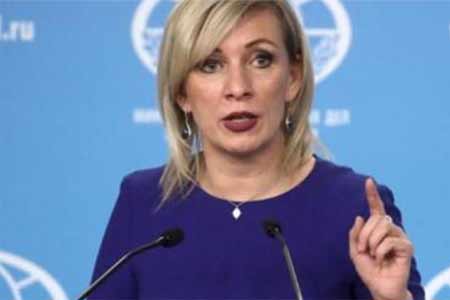 Zakharova: Armenia`s pro-EU pivot poses economic security risks to EAEU member states
 It`s time for South Caucasus countries to think of South Caucasus as single, unified region - RA premier
  Pashinyan: Armenia and Azerbaijan should leave each other alone
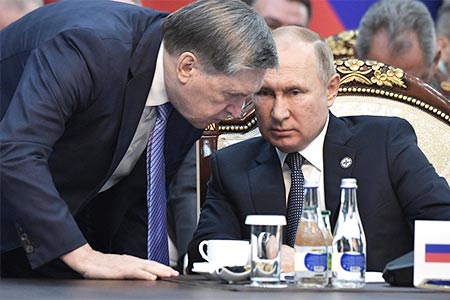 Moscow sees situation with Armenia as attempt to attack Russia-involving integration associations - Russian presidential aid