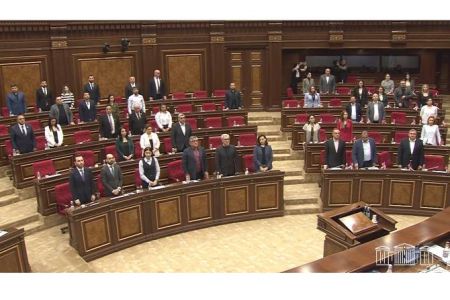
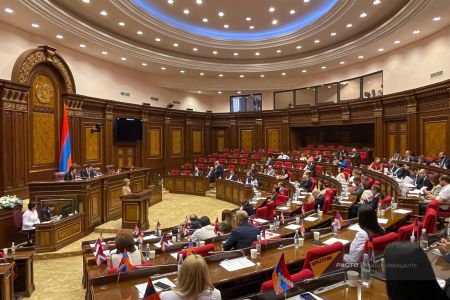
ArmInfo. At its meeting on June 23, the Yerevan Council of Elders voted by a majority vote to rename Arsen Amiryan Street King Pap Street.
Yerevan Mayor Tigran Avinyan noted that this issue was included in the list of items not subject to discussion at the meeting, as it had already been agreed upon. However, representatives of opposition factions opposed this approach, proposing that it be reclassified as a matter for discussion.
In particular, Vahagn Avagyan, a member of the Council of Elders from the Public Voice faction, stated that his political party opposes this project. He was supported by Manuk Sukiasyan, a member of the Council of Elders from the Mother Armenia faction, who noted that there is a lack of consensus on this issue both within the Council of Elders and in society. In this regard, he recalled that the question of renaming the street has been up for vote since April of this year on the Active Citizen platform. According to him, the post has only garnered 226 views: 30 people voted for the renaming, and 7 voted against.
Sukiasyan emphasized that he does not object to the establishment of a street named after King Pap in Yerevan, but in this case, he believes, it seems the main goal is to abandon the name "Amiryan."
In response, Mayor Tigran Avinyan stated that, with all due respect to the descendants of Arsen Amiryan, he does not believe that this man embodies the values in whose honor one of Yerevan's central streets adjacent to Republic Square should be named.
The list of non-negotiable issues also included decisions to rename several other streets in the capital, which will be named after Gurgen Edilyan, Avet Terteryan, Anania Shirakatsi, Konstantin Yerznkatsi, Grigor Yeghiazaryan, and Eduard Baghdasaryan.
A total of 31 members of the Council of Elders voted in favor of the non-negotiable issues, 15 voted against, and five abstained.
As a reminder, Arsen Amiryan was a Bolshevik revolutionary, journalist, and one of the 26 Baku Commissars.
He was born in Baku in 1881 to an Armenian family. He studied law at Kyiv University, participated in the revolutionary movement, worked as a journalist, and was the editor of the Bolshevik newspaper "Bakinsky Rabochiy." During the events of 1918, he was a member of the leadership of the Baku Commune. After the fall of the commune, he was arrested and executed in September 1918 along with other Baku commissars in Transcaspia.






 Expert: Current process is not about peace, but implementing Azerbaijan`s wishlist
 Expert: Real peace unattainable until Armenia-Azerbaijan agreement is signed and ratified
 TRIPP`s proximity to Iranian border could slow its implementation - expert
  Who and why is sacrificing RA National Security Service`s reputation? - expert
  Tehran creating security environment in which sustainable shipping in Strait of Hormuz difficult to imagine without its direct participation - expert
  Arrested Armenian oligarch on economy and new jobs
  NA Vice Speaker candidate believes his wife`s salary as director of HayPost is the lowest in the company`s history
 RF Permanent Representative: There is no CSTO-Armenia conflict
 Moscow: NATO seeking to "Pull" Armenia away from CSTO Allies
  Political analyst: Russia intends to determine which "Camp" Armenia will choose through a referendum
 Narek Karapetyan will give up his parliamentary salary in favor of charitable contributions.
 Armenian analyst: Developing relations with Europe and the U.S. must not jeopardize relations with regional powers
 Armenia and France discuss further development of strategic partnership and EU cooperation
  To overcome risks Armenia must reduce domestic escalation - expert
  Zatulin: Pashinyan was eager to get back to Russia because he actually lost the elections
 Human rights activist Ruben Melikyan dismissed from YSU
 Pashinyan removed from INNOPROM guest list
 Zakharova: Armenia`s pro-EU pivot poses economic security risks to EAEU member states
 It`s time for South Caucasus countries to think of South Caucasus as single, unified region - RA premier
  Pashinyan: Armenia and Azerbaijan should leave each other alone