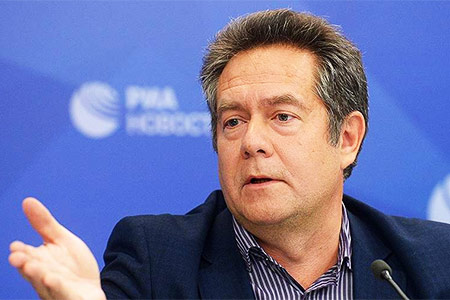
ArmInfo.Russia's trade restrictions and import bans on certain Armenian goods cannot frighten Armenia, as they constitute another "shot in the foot." This opinion was expressed by Nikolai Platoshkin, a Russian diplomat, former head of the Russian Foreign Ministry's Armenia department, and political scientist, commenting on recent Russian statements amid the start of Armenia's accession process to the European Union (EU).
As Platoshkin recalled, Russia similarly intimidated Moldova and Georgia. But, as the expert noted, the only result was that these countries found other markets. "Now we've banned the import of Jermuk mineral water, cognac, wine, flowers, and fruit from Armenia. Of course, this has hit Armenian producers, but it's also hit Russian consumers. And are those who produce this mineral water or sell flowers anti-Russian or pro-EU?" the political scientist asked rhetorically.
Platoshkin is convinced that Russia is thus only losing the trust of Armenian producers and demonstrating that, if anything happens, the country will stop buying from them. "It turns out that with these bans, they're giving ammunition to anti-Russian forces in Armenia. In other words, these sanctions only hit Russia and aid anti-Russian forces in Armenia," the political scientist asserted.
Similarly, he added, Armenia will find new ways to organize gas supplies to the country, for example, through Azerbaijan or Iran. In this regard, he recalled the existence of a gas pipeline from Iran, through which a quarter of Russia's gas supplies pass. "Furthermore, this will also be beneficial for Iran, since this gas pipeline is not subject to the blockade of the Strait of Hormuz. Furthermore, we must remember the vast Caspian Sea deposits. There's enough gas there not only for Armenia. Azerbaijan and Kazakhstan are already producing gas. In other words, a gas pipeline across the Caspian Sea has already been built," the expert noted.
Platoshkin also mentioned Azerbaijan's oil product supplies to Armenia. "And it (Azerbaijan - ed.) can easily separate Armenia from Russia economically if it sets such a goal. This doesn't even require massive investment. And after that, Russia will wonder why they stepped on the same rake as Georgia, Moldova, and the Czech Republic," the political scientist believes.
Thus, according to the expert, putting pressure on Armenia economically is futile. The country's security is another matter entirely. In this regard, he noted the lack of guarantees that Azerbaijan and Turkey will not attack Armenia in the future. "Armenia has no chance of standing up to these two countries, as the balance of power is not in Armenia's favor, and its geostrategic rivals have significant advantages. And of course, as long as Russian border troops guard the border between Armenia and Turkey, they won't bother to intervene, as it would be perceived as an attack on Russia. But if Armenia chooses the option of withdrawing the 102nd Russian base, the question will arise: who will replace it? We must understand that the economy is a matter of time, and trying to force Armenia's hand is futile. But the issue of security is important, and the Armenian people need to carefully study it, because there is no room for error here. While Armenia has questions for Russia, and many of them are justified, it must first and foremost think about the future generation and the preservation of the country. Moreover, I am convinced that a strong Armenia is also beneficial to Russia," Platoshkin concluded. '
As a reminder, Russia imposed restrictions on the import of Armenian flowers on May 22, and on fruits and vegetables on May 20. Rospotrebnadzor, the Federal Service for Surveillance on Consumer Rights Protection and Human Wellbeing, suspended the sale of 64.5 million units of Jermuk mineral water in Russia on May 28. The order was based on the manufacturer's violations of mandatory technical regulation requirements. It is noteworthy that all of this began after the Armenian government approved the draft law on January 9, 2025, to initiate the process of joining the European Union. The law was finally adopted by the country's parliament on March 26, and signed by the Armenian president on April 4 of that year.
Moscow then stated that Russia had conveyed to Armenia that simultaneous membership in the Eurasian Economic Union and the European Union was impossible. On May 9, 2026, Russian President Vladimir Putin, speaking to journalists, suggested that Armenia decide on its membership in the EU and the EAEU as soon as possible, expressing its readiness to "begin a civilized divorce" if necessary. Yerevan responded by stating that it would leave the EAEU when it deemed it necessary. On May 29, 2026, the Russian president again addressed this issue, recalling that, according to preliminary expert estimates, Armenia's withdrawal from the Eurasian Economic Union (EAEU) would lead to a loss of at least 14% of its GDP. He also called on the Armenian side to hold a referendum as soon as possible on whether Armenia should be part of the EAEU or the EU.













 Opinion: Following Berlin talks, Baku gains expanded influence within EU and strengthens cooperation ties with main European powerhouse
 Zatulin: Pashinyan was eager to get back to Russia because he actually lost the elections
 Human rights activist Ruben Melikyan dismissed from YSU
 Pashinyan removed from INNOPROM guest list
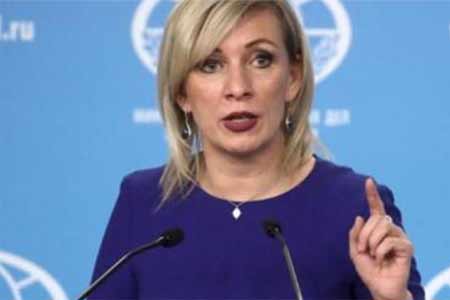 Zakharova: Armenia`s pro-EU pivot poses economic security risks to EAEU member states
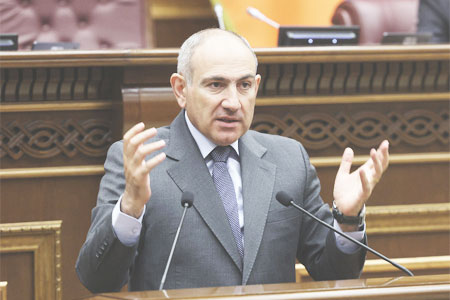 It`s time for South Caucasus countries to think of South Caucasus as single, unified region - RA premier
  Pashinyan: Armenia and Azerbaijan should leave each other alone
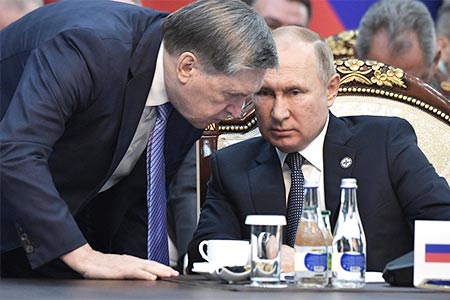 Moscow sees situation with Armenia as attempt to attack Russia-involving integration associations - Russian presidential aid
 Zakharova: Armenia views relations with Russia as tool for financially securing reorientation toward EU
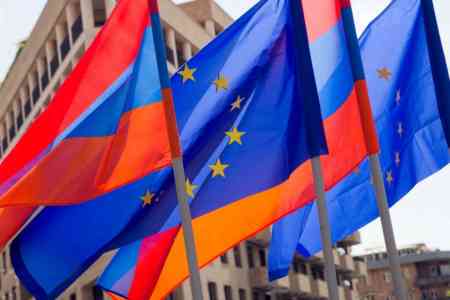 The Armenian Minister of Justice and the EU Ambassador discussed visa liberalization issues for Yerevan.
 Azerbaijan`s aggressive plans against Armenia became possible in wake of Pashinyan`s decisions on Artsakh - expert
  Zakharova: Russia sent a note of protest to Armenia over the act of vandalism at the "Mother Armenia" memorial in Gyumri