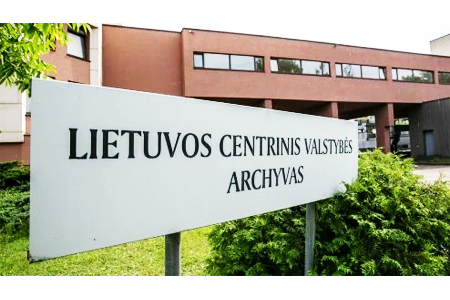
ArmInfo.Publications dedicated to the Armenian Genocide have been restored on the website of Lithuania’s state archives, orer.eu reports.
"On May 8, information was received from Lithuanian government circles that all publications dedicated to the Armenian Genocide had been restored on the archive’s website," the report stated.
Earlier, delfi.lt, based on an account from a person working at the archive, reported that the Central State Archives of Lithuania, having received an unofficial "push" from the Ministry of Foreign Affairs (MFA) and the Turkish Embassy, removed a publication dedicated to the Armenian Genocide in the Ottoman Empire. The head of Lithuania’s central archive service, Inga Zaksauskien, confirmed that an urgent meeting with representatives of the Turkish embassy had taken place on April 28. During the meeting, the archive was allegedly accused of politicizing the issue of the Armenian Genocide. “Concern was expressed about why the State Archives were allowing themselves to publish and disseminate what may be political issues,” Zaksauskien said.
Zaksauskien stressed that both her service and the archive remain apolitical, and drew a sharp comparison to other contested historical issues involving Lithuania. “I do not see that the archive has gotten involved in politicizing any issue with its publication. Russia also does not recognize that it deported Lithuanians to Siberia, but we do not discuss that. Turkey also has this view on the Armenian genocide question, but that is their view,” she said. “My current position is that this is absolutely not a political issue. It is a record of historical facts confirmed by scientific research,” Lithuania’s chief archivist stressed. She also said she had received no official letters or phone calls regarding the matter, describing the embassy meeting as an exercise in soft power.
“I received absolutely no official letter or phone call. It was simply a visit, which I would describe as an instrument of soft power, aimed at politely explaining their position while reminding us that we could look for common points in Turkish and Lithuanian history — of which, frankly, we do not have many,” Zaksauskien noted.
Regarding the Lithuanian Foreign Ministry’s involvement, the head of the central archive’s document dissemination department, Dziuginta Abromaitien, said she had received an informal phone call from ministry representatives. “The Foreign Ministry expressed concern that the publication posted on the archive’s website could damage long-term relations between Lithuania and Turkey,” she said.
However, the Foreign Ministry denied issuing any recommendations or instructions to state institutions on the matter, stating it “has not provided any recommendations to the Archives Department, to the Chief Archivist’s Service, or to any other state institution on this issue.”
Lithuania’s Parliament, Seimas, adopted a resolution on December 15, 2005, condemning the Armenian Genocide committed in the Ottoman Empire between 1915 and 1923. The European Parliament formally recognized the Armenian Genocide in a resolution on April 15, 2015. Turkey, by contrast, does not recognize that the Ottoman Empire committed genocide against the Armenian people.











 Expert: Gagik Tsarukyan embodies post-Soviet model of big business-state relations; this model is used in many other post-Soviet countries
 Expert: Azerbaijan promoting aggressive plans against Armenia at state level
 Iranologist: Baku`s propaganda of might masks the country`s inability to provide water to its own population
 Moscow: NATO seeking to "Pull" Armenia away from CSTO Allies
  Political analyst: Russia intends to determine which "Camp" Armenia will choose through a referendum
 Narek Karapetyan will give up his parliamentary salary in favor of charitable contributions.
 Armenia and France discuss further development of strategic partnership and EU cooperation
  To overcome risks Armenia must reduce domestic escalation - expert
  Zatulin: Pashinyan was eager to get back to Russia because he actually lost the elections
 Human rights activist Ruben Melikyan dismissed from YSU
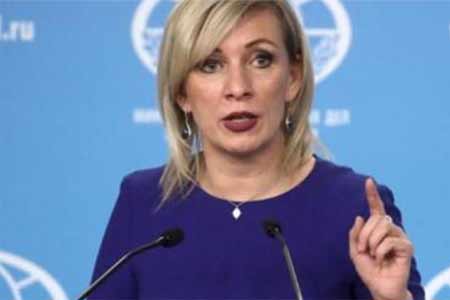 Zakharova: Armenia`s pro-EU pivot poses economic security risks to EAEU member states
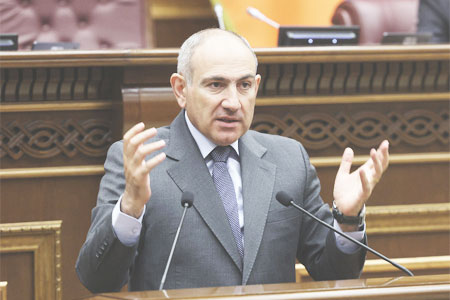 It`s time for South Caucasus countries to think of South Caucasus as single, unified region - RA premier
  Pashinyan: Armenia and Azerbaijan should leave each other alone
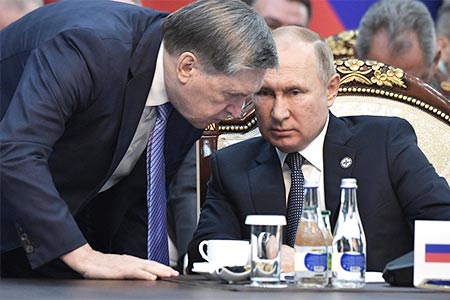 Moscow sees situation with Armenia as attempt to attack Russia-involving integration associations - Russian presidential aid