
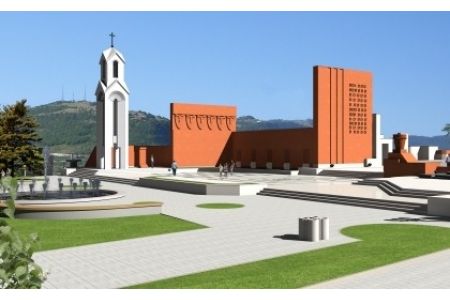
ArmInfo. Caucasus Heritage Watch (CHW), an organization that monitors Artsakh's cultural heritage, has documented more compelling evidence of Azerbaijan's policy aimed at the systematic destruction of Armenian historical and cultural heritage in occupied Artsakh, as stated by the Ombudsman of the Artsakh Cultural Heritage and Vice President of the Azgayin historical and cultural NGO, Hovik Avanesov.
"The complete destruction of the monument dedicated to the 100th anniversary of the Armenian Genocide, at the Stepanakert Memorial Complex, cannot be viewed as an isolated incident: it clearly fits into a broader process of systematic destruction of cultural heritage and the erasure of historical memory. The white marble bell tower, which housed a reliquary containing human remains from Deir ez-Zor, held a special symbolic significance. Deir ez-Zor is not only a geographical name in the collective memory of Armenians, but also a symbol embodying the tragic culmination of the genocide, a place where hundreds of thousands of Armenians were subjected to mass murder, forced deportations, and death marches. The destruction of such a monument signifies not only the loss of material value but also a direct blow to historical memory, the memory of the victims, and the identity of their descendants," Avanesov writes.
According to him, satellite data from Airbus and Planet Labs clearly shows that the monument and the entire surrounding memorial complex were destroyed between July 14, 2025 and April 25, 2026. Avanesov added that this data chronology does not indicate random damage, but a deliberate and phased operation aimed at completely "cleansing" the area of any traces of Armenian presence. "This action should be considered in the context of international law and the protection of cultural heritage. The deliberate destruction of cultural heritage sites contravenes several international conventions, including documents adopted under the auspices of UNESCO. However, this case demonstrates that such actions continue, often with impunity, which encourages their repetition.
Furthermore, the destruction of the monument is not only cultural but also clearly political and ideological in nature. The goal is to reshape the historical narrative of the territory, erase evidence of Armenian presence, and create an 'empty' historical space," Avanesov asserted.
He emphasized that this is a classic example of cultural genocide, where not only people are destroyed, but also their memory, culture, and material evidence of their existence. "Therefore, the destruction of the bell tower dedicated to the 100th anniversary of the Armenian Genocide in Stepanakert should not be viewed as an isolated incident, but as an integral part of a continuous and systematic policy aimed at destroying Armenian historical and cultural heritage and distorting historical memory. This reality requires not only scientific documentation but also a clear and practical response from the international community," Avanesov concluded.
It should be noted that since the occupation of Artsakh, Azerbaijan has completely destroyed or significantly damaged the following cultural and religious sites. The Kanach Zham (Surb Hovhannes Mkrtich) Church in Shushi was completely destroyed in April 2024, the Ghazanchetsots Cemetery in Shushi was completely destroyed, the village of Karintak was completely bulldozed, and monuments and busts in Stepanakert, including those of Charles Aznavour, Hovhannes Aivazovsky, Hovhannes Tumanyan, and Marshal Baghramyan, were dismantled. The Marshal Khudyakov Museum in the village of Mets Tager was destroyed. Today, approximately 4,000 Armenian cultural sites remain under Azerbaijani control, including more than 370 churches and 119 ancient fortresses.


































 Analyst: The primary issue with Armenia`s new Parliament Speaker`s speech lies is its one-sided interpretation of the causes of the political crisis
 Expert: Gagik Tsarukyan embodies post-Soviet model of big business-state relations; this model is used in many other post-Soviet countries
 Expert: Azerbaijan promoting aggressive plans against Armenia at state level
 Iranologist: Baku`s propaganda of might masks the country`s inability to provide water to its own population
 NA Vice Speaker candidate believes his wife`s salary as director of HayPost is the lowest in the company`s history
 RF Permanent Representative: There is no CSTO-Armenia conflict
 Moscow: NATO seeking to "Pull" Armenia away from CSTO Allies
  Political analyst: Russia intends to determine which "Camp" Armenia will choose through a referendum
 Narek Karapetyan will give up his parliamentary salary in favor of charitable contributions.
 Armenia and France discuss further development of strategic partnership and EU cooperation
  To overcome risks Armenia must reduce domestic escalation - expert
  Zatulin: Pashinyan was eager to get back to Russia because he actually lost the elections
 Human rights activist Ruben Melikyan dismissed from YSU
 Zakharova: Armenia`s pro-EU pivot poses economic security risks to EAEU member states
 It`s time for South Caucasus countries to think of South Caucasus as single, unified region - RA premier
  Pashinyan: Armenia and Azerbaijan should leave each other alone
 Moscow sees situation with Armenia as attempt to attack Russia-involving integration associations - Russian presidential aid