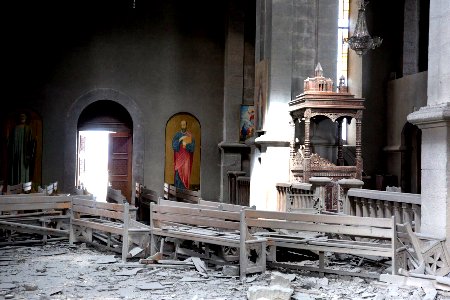
ArmInfo. The International and Comparative Law Center , in cooperation with the Armenian Legal Center for Justice and Human Rights, has submitted a written report to the British Parliament on the destruction of cultural heritage in Nagorno-Karabakh.
According to the ARF press service, the report was submitted as part of an investigation initiated by the International Bar Association's Human Rights Institute, which took place in the British Parliament in January-February 2026. The investigation is being conducted jointly with the All-Party Parliamentary Group on International Law, Justice and Accountability and the All-Party Parliamentary Group on Armenia. Since 2021, the International and Comparative Law Center has been conducting ongoing monitoring, documentation, and legal assessments of the state of Armenian cultural and religious heritage in Nagorno-Karabakh. The Center's research is based on a multi-layered methodology, including the study of high-resolution satellite imagery, open-source verification methods, consultations with international experts, analysis of official Azerbaijani statements, and testimonies from representatives of displaced communities, supplemented by materials from international monitoring platforms and academic sources.
The Center's research shows that since 2021, numerous important sites of Armenian cultural heritage, including churches, monasteries, cemeteries, historic villages, and monuments, have been vandalized, structurally altered, or simply destroyed. Satellite surveys conducted by independent monitoring organizations also confirm the physical destruction of numerous settlements formerly inhabited by Armenian communities.
The research shows that the recorded incidents occurred in a variety of circumstances, ranging from damage caused by military action to post-war changes, such as the transformation of cultural landscapes and the removal of Armenian inscriptions and symbols. While each case is the subject of an individual study and occurred in specific circumstances, the overall picture points to repeated and ongoing damage to the heritage that bears cultural identity. Forcibly displaced residents of Artsakh are deprived of the opportunity to visit the graves of their relatives and carry out memorial and mourning ceremonies, that play an important role in Armenian culture.
International law considers the protection of cultural heritage an important obligation. The 1954 Hague Convention and its Additional Protocols obligate states to protect cultural property during armed conflict. Furthermore, the destruction of cultural heritage may violate the rights to private and family life, freedom of religion, and participation in cultural life, in accordance with the European Convention on Human Rights and other international instruments. The report also addresses the lack of access to Nagorno-Karabakh for independent international missions, which is a serious obstacle to a full assessment of the state of cultural heritage.
The report notes the existence of serious risks of violation of international obligations to protect cultural heritage. It emphasizes that the destruction of cultural monuments or the alteration of their identity may entail both the international legal responsibility of the state and individual criminal liability under international criminal law. "The protection of Nagorno-Karabakh's cultural heritage requires a coordinated international response. It is necessary to ensure the access of independent international experts to the region to conduct ongoing monitoring, as is the protection of the cultural rights of displaced persons. The International and Comparative Law Center continues its fact-finding and analytical work to promote the preservation of Armenian cultural heritage and the development of effective mechanisms of accountability and protection within the framework of international law," the statement reads.

















 Who and why is sacrificing RA National Security Service`s reputation? - expert
  Tehran creating security environment in which sustainable shipping in Strait of Hormuz difficult to imagine without its direct participation - expert
  Arrested Armenian oligarch on economy and new jobs
  NA Vice Speaker candidate believes his wife`s salary as director of HayPost is the lowest in the company`s history
 RF Permanent Representative: There is no CSTO-Armenia conflict
 Moscow: NATO seeking to "Pull" Armenia away from CSTO Allies
  Political analyst: Russia intends to determine which "Camp" Armenia will choose through a referendum
 Narek Karapetyan will give up his parliamentary salary in favor of charitable contributions.
 Armenian analyst: Developing relations with Europe and the U.S. must not jeopardize relations with regional powers
 Armenia and France discuss further development of strategic partnership and EU cooperation
  To overcome risks Armenia must reduce domestic escalation - expert
  Zatulin: Pashinyan was eager to get back to Russia because he actually lost the elections
 Human rights activist Ruben Melikyan dismissed from YSU
 Pashinyan removed from INNOPROM guest list
 Zakharova: Armenia`s pro-EU pivot poses economic security risks to EAEU member states
 It`s time for South Caucasus countries to think of South Caucasus as single, unified region - RA premier
  Pashinyan: Armenia and Azerbaijan should leave each other alone