
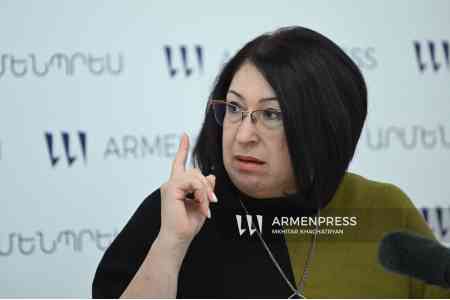
ArmInfo. New conditions came into effect on March 1, 2026, under which foreign citizens arriving in Russia may be placed on the registry of controlled persons and subject to deportation. This was announced by Tatevik Bezhanyan, migration program expert at Armenian Caritas, at a press conference in Yerevan on March 4.
She explained that these changes are a logical continuation of the reforms initiated by Russian authorities in February 2025, when a new "expulsion regime" for migrants was introduced and the rules for maintaining the registry of controlled persons were updated. As the expert noted, the tax service certificate format changed from paper to electronic, effective March 1, 2026. The absence of an electronic statement may result in an individual being added to the registry of controlled individuals.
According to Bezhanyan, the salary amount specified in migrants' employment contracts may also result in their name appearing on this registry. The expert added that large transfers from one person to different families may also lead to inclusion on the registry of controlled individuals and potential deportation. To avoid such situations, Bezhanyan urged migrants to transfer only their own funds and to include the actual salary amount in their employment contracts.
Since March 1, the expert continued, the Federal Security Service of Russia has been able to request that telecom operators disconnect migrants' access to telephones depending on the nature of their calls. "Migrants in Moscow and the Moscow region could face particularly serious problems, since, starting in September 2025, citizens, including Armenians, must use the online "Amina" app to obtain migration registration. Failure to update the app could result in a person being added to the registry of controlled individuals and subsequent deportation if the FSB discovers anything they deem a threat to the country," Bezhanyan noted. The expert explained that this could affect citizens who, for example, sympathize with Ukraine. In this regard, she urged Armenian citizens to be careful about the type of calls they make and the content of the calls.
In this regard, the expert also added that if a person lives at the stated address but plans to be absent for three days, they should report their absence to the local police at their place of registration. Bezhanyan cited the decision, which stipulates that if a homeowner refuses to register someone as a resident, they will be fined 5,000 rubles (approximately 24,000 drams - ed.) as a positive change. If the person is a legal entity or official, the fine increases to 500,000 rubles (over 2 million drams - ed.).
"Starting March 1, regions will also be given the opportunity to decide how many foreign citizens can be employed in each job. If there are currently more foreign citizens than required, the employer must fire them and fill the positions with Russian citizens," the expert added. Bezhanyan reported that the issue of not applying this change to citizens of EAEU countries is being discussed. She expressed hope that it will be adopted, as otherwise it will have negative consequences. "Due to changes after 2022, we have recorded a downward trend in migration flows to Russia. While in 2022-2023, we were talking about 95,000-100,000 labor migrants, today that number doesn't even reach 70,000. In 2023-2024, we also noticed that, due to the ruble's depreciation because of the sanctions, it became unprofitable to send money to their families in Armenia, and people began taking family members with them. However, this trend started to decline on April 1, 2025, when conditions became more stringent, for instance, those related to the admission of migrant children to school," the expert noted. Another reason for being added to the registry, according to Bezhanyan, could be the expiration date of one's migration card. The expert explained that while it was valid indefinitely until September 2025, it is now issued for 90 days, and individuals must go to the migration service at their place of registration and have the card stamped on the back before the expiration date. Bezhanyan also acknowledged that the war around Ukraine and the tightening of migration regulations have essentially contributed to a reduction in migration from Armenia to Russia. This, she added, was also influenced by the intensification of construction in the country.
Recvall, on February 5, 2025, a law on a registry of controlled persons came into effect in Russia, introducing a so-called "expulsion regime." This law provides for sanctions against foreign citizens who violate residence regulations. Such individuals are added to the registry, after which their bank accounts are frozen, and all transactions become impossible. And as of March 1 of this year, amendments were made to it.


























 Expert: Real peace unattainable until Armenia-Azerbaijan agreement is signed and ratified
 TRIPP`s proximity to Iranian border could slow its implementation - expert
  Who and why is sacrificing RA National Security Service`s reputation? - expert
  Tehran creating security environment in which sustainable shipping in Strait of Hormuz difficult to imagine without its direct participation - expert
  Arrested Armenian oligarch on economy and new jobs
  NA Vice Speaker candidate believes his wife`s salary as director of HayPost is the lowest in the company`s history
 RF Permanent Representative: There is no CSTO-Armenia conflict
 Moscow: NATO seeking to "Pull" Armenia away from CSTO Allies
  Political analyst: Russia intends to determine which "Camp" Armenia will choose through a referendum
 Narek Karapetyan will give up his parliamentary salary in favor of charitable contributions.
 Armenian analyst: Developing relations with Europe and the U.S. must not jeopardize relations with regional powers
 Armenia and France discuss further development of strategic partnership and EU cooperation
  To overcome risks Armenia must reduce domestic escalation - expert
  Zatulin: Pashinyan was eager to get back to Russia because he actually lost the elections
 Human rights activist Ruben Melikyan dismissed from YSU
 Pashinyan removed from INNOPROM guest list
 Zakharova: Armenia`s pro-EU pivot poses economic security risks to EAEU member states
 It`s time for South Caucasus countries to think of South Caucasus as single, unified region - RA premier
  Pashinyan: Armenia and Azerbaijan should leave each other alone