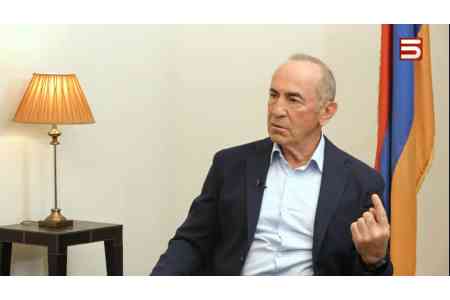
ArmInfo. Not a single opposition political force in Armenia has spoken about invalidating the November 9, 2020, trilateral statement that ended hostilities in the Nagorno-Karabakh conflict zone. This was stated by Armenia's second president, Robert Kocharyan, in an interview with Channel 5, referring to the 44-day war and the mistakes made by the authorities during those days.
Kocharyan stated that all political forces understood that, despite the document being quite problematic and recording the war's dismal results for the Armenian side, the November 9 statement was nevertheless an opportunity to preserve Artsakh. "At that moment, we had to cling to this document and do everything possible to ensure its implementation. Compare paragraph 9 of this document with the similar paragraph of the Washington document of August 8 of this year. They are identical in content, the only difference being that back then, there was Artsakh and the Lachin corridor," the politician said.
Kocharyan is confident that Armenian Prime Minister Nikol Pashinyan's refusal to implement paragraph 9 of the trilateral statement of November 9, 2020, led to the blockade of Artsakh and its loss. He also believes that a similar Washington document is now being presented as the deal of the century, especially given the loss of Artsakh and the Lachin corridor.
Regarding the reasons for the loss of Artsakh and the outbreak of hostilities, the second president of Armenia noted that approximately a year before the start of the 44-day war, it was clear to him that everything was being done to provoke a war. He is confident that the war was caused by the breakdown of the negotiation process, and due to the fault of the Armenian side. "The Armenian side has refused to negotiate for the first time in the history of negotiations.
In 2021, the Armenian authorities refused to negotiate on the proposal of the OSCE Minsk Group co-chairs, declaring that they were starting from scratch and let them negotiate with Nagorno-Karabakh. And with the phrase 'Artsakh is Armenia, period!' Nikol Pashinyan dashed all expectations. Add to this the discrediting of the army command, which led to the weakening of the army, the deterioration of relations with a strategic ally, and the discrediting of the CSTO," the politician said. For the international community, the Armenian side was the one torpedoing the negotiations.
According to him, under the current circumstances, Azerbaijan had no choice but to launch military action. Kocharyan is confident that the policy pursued by the Armenian authorities since 2018 to weaken the army was one of the positive signals for the outbreak of hostilities. He added that another pretext for Azerbaijani aggression was the operation on the northeastern border of the Armenian-Azerbaijani border, the scale of which was inflated and almost equated in significance to the Battle of Sardarapat. Kocharyan is confident that the above-mentioned circumstances created the ideal conditions for Azerbaijan to initiate war, and given Armenia's breakdown in the negotiation process, no one condemned this aggression.
He also noted that in recent years, the Armenian prime minister has openly stated that Artsakh was a burden for Armenia, and by relinquishing it, Yerevan freed itself from this burden and "gained independence." The former Armenian president expressed his conviction that the war would not have happened if the Armenian authorities had not made these grave mistakes.
When asked what the outcome of the Artsakh negotiation process would have been without the Armenian authorities' actions, Kocharyan expressed his belief that the negotiation process would have ended with the adoption of a modified version of the Madrid Principles. "If Nikol Pashinyan had joined the negotiation process in 2019-the OSCE Minsk Group proposal was a good one-then everything would have ended with the signing of such a document," Kocharyan said.
When asked whether any of the authorities consulted him during the war, Kocharyan denied it, adding that Pashinyan is incapable of accepting anyone's advice. "The most incomprehensible thing for me is that during the war, on October 18-19, Nikol Pashinyan rejected the Russian side's offer to end the war. Azerbaijan agreed, but Nikol Pashinyan rejected it, knowing full well he would lose the war, since the General Staff reported that the army did not have the resources to continue military operations. This decision cost our people at least 2,500 additional deaths and 5,000-6,000 wounded," the politician noted.
Kocharyan also added that he was in Karabakh on the second day of the war, and what he saw in the first two days convinced him that the Armenian side would lose. "Every day, through Bako Sahakyan and Arkady Ghukasyan, I tried to convince Arayik Harutyunyan to do everything possible to stop the war. I had a clear plan of action, but Arayik Harutyunyan was afraid to meet with me, conveying through Bako Sahakyan that 'the Armenian prime minister would eat him if he met with me.' In other words, at that time, people feared Azerbaijan less than the Armenian prime minister," he continued.
Kocharyan added that he was certain the Armenian side would lose because such personnel changes had been made in the Armenian army, and people incapable of making decisions had been appointed to leadership positions based on loyalty to the authorities. According to him, another indicator of a negative outcome for us was the shameful mobilization organized by the current authorities.
The politician is certain that the current authorities failed to take a single normal step during the fighting, starting with distributing combat medals to the commanders of the retreating army. According to him, this was done not to reward combat effectiveness, but to encourage defeat. "The disinformation spread during the war became the main cause of desertion. The management of the war was a failure on all fronts," he said.
Kocharyan also noted that on the second or third day of the war, almost the entire population was evacuated from Nagorno-Karabakh, even from remote rear-line villages where it was unnecessary. According to him, this created panic and a mood of surrender in Nagorno-Karabakh.














 Expert: Gagik Tsarukyan embodies post-Soviet model of big business-state relations; this model is used in many other post-Soviet countries
 Expert: Azerbaijan promoting aggressive plans against Armenia at state level
 Iranologist: Baku`s propaganda of might masks the country`s inability to provide water to its own population
 Moscow: NATO seeking to "Pull" Armenia away from CSTO Allies
  Political analyst: Russia intends to determine which "Camp" Armenia will choose through a referendum
 Narek Karapetyan will give up his parliamentary salary in favor of charitable contributions.
 Armenia and France discuss further development of strategic partnership and EU cooperation
  To overcome risks Armenia must reduce domestic escalation - expert
  Zatulin: Pashinyan was eager to get back to Russia because he actually lost the elections
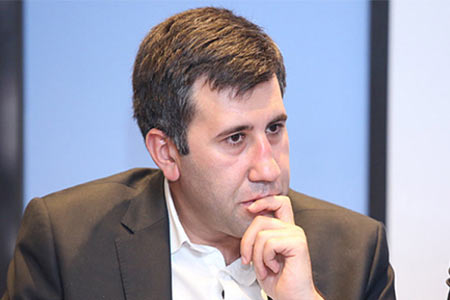 Human rights activist Ruben Melikyan dismissed from YSU
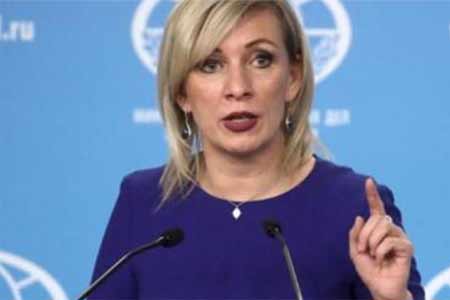 Zakharova: Armenia`s pro-EU pivot poses economic security risks to EAEU member states
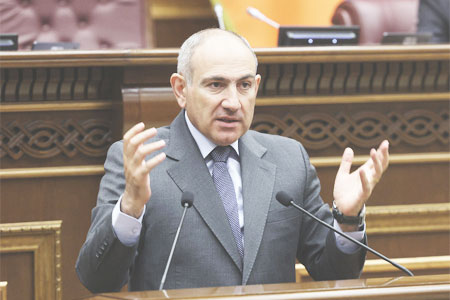 It`s time for South Caucasus countries to think of South Caucasus as single, unified region - RA premier
  Pashinyan: Armenia and Azerbaijan should leave each other alone
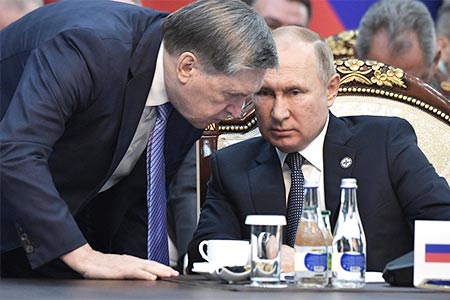 Moscow sees situation with Armenia as attempt to attack Russia-involving integration associations - Russian presidential aid