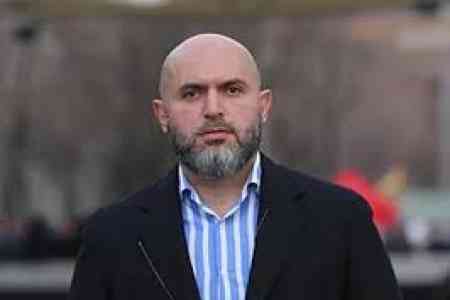
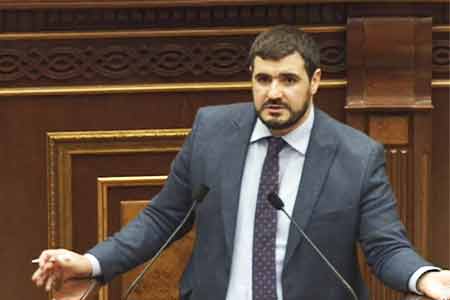
ArmInfo. Arguments in the style of "since he is still the Prime Minister, it means the people agree with his policy" do not work. This is how Deputy Chairman of the Republican Party of Armenia (RPA) Armen Ashotyan commented on the article by Russian Foreign Minister Sergey Lavrov, published today in Novaya Gazeta, which includes a section on Nagorno- Karabakh.
Ashotyan noted that he read with great interest Lavrov's article dedicated to the 50th anniversary of the Helsinki Final Act and the creation of the OSCE.
"The subject of my modest reaction to Minister Lavrov's programmatic article is not so much a global assessment of the organization's activities - in this regard, I will allow myself to agree with many of the arguments presented by the minister - as the regional dimension of the OSCE mandate in the person of its Minsk Group for the settlement of the Nagorno-Karabakh conflict," Ashotyan noted.
The RPA Deputy Chairman believes that Lavrov's assessment of the work of the only international legitimate format for finding a mutually acceptable solution to the most long-standing and bloody conflict on the territory of the former Soviet Union is frankly discouraging with its double standards, washing his hands and attempting to remove responsibility from himself - in the best traditions of Western diplomacy, so disliked by Mr. Lavrov, and an actual repetition of Aliyev's (sic!) narrative about the activities of the OSCE Minsk Group.
Speaking about the policy of double standards, the Armenian politician noted that assessing the work of the Minsk Group as "the OSCE failed in Nagorno-Karabakh as well. The Minsk Group was unable to create conditions for dialogue between the conflicting parties:", the respected minister literally a paragraph above, mentioning the Transnistrian conflict, despite the unresolved nature of the problem, not only refrains from such harsh and uncompromising statements, but also expresses his regret about the future of the "5 + 2" format, which, in his words, is being "killed" by Western partners. "
Another example of double standards in the article are the numerous references to the principle of the inviolability of borders and the silence on the principle of the right of people to self-determination, mentioned in the same Helsinki Final Act as one of the 10 principles. Such one-sidedness is surprising, since high-ranking Russian officials, including Mr. Lavrov, very often refer to the principle of self- determination in the context of the war in Ukraine and thereby support their diplomatic position. Let me remind you that this principle is one of the three pillars on which the OSCE Minsk Group developed the basic principles for the settlement of the Nagorno-Karabakh conflict," Ashotyan noted.
According to him, while rightly criticizing the silence of the West, including the OSCE institutions, regarding religious persecution in various members of the organization, Mr. Lavrov mentions the persecution of the Estonian Orthodox Church, while bypassing the attacks of the current Armenian regime on the Armenian Apostolic Church.
"In addition, if, according to Lavrov, the OSCE Minsk Group was ineffective, then it should be remembered that this group, consisting of nine states, delegated its main powers to the three co-chairs, among which the Russian Federation played a leading role. Moreover, Lavrov himself participated in dozens of meetings in both bilateral and multilateral formats, the purpose of which was to develop a mutually acceptable formula for a fair resolution of this conflict," the politician noted.
In this vein, he added that it is no secret that numerous proposals by the OSCE Minsk Group co-chairs were torpedoed by the destructive approach of the Azerbaijani leadership, in response to which the co-chairs, including Russia, refrained from at least publicly criticizing Aliyev and from effective measures to influence the Azerbaijani position. Ashotyan is sure that this contributed to the prolongation of the conflict, the undermining of the authority of the co-chairs in the international arena and the unpunished cynicism of the Azerbaijani leadership.
"As painful and sad as it may be, it should also be mentioned that after the trilateral statement of November 9, 2020, the main initiative to maintain peace in the region passed to the Russian Federation. Yes, before the start of the Joint Military Operations, the OSCE Minsk Group continued to function. This is confirmed by a number of statements and meetings of the group's co-chairs. However, "on the ground", both the political, military and humanitarian components of the conflict were under decisive Russian influence. And no one has canceled additional Russian obligations in this context," the RPA Deputy Chairman believes.
Touching upon the position of official Baku, Ashotyan admitted that President Aliyev had criticized the activities of the OSCE Minsk Group before, but after the ethnic cleansing of Nagorno-Karabakh and the de- Armenization of the region, the rhetoric of the Azerbaijani leadership violates both the specific principles of the Helsinki Final Act and is full of cynicism and impudence towards the group's co-chair countries.
"It is strange that Minister Lavrov's position on the assessment of the ineffective activities of the OSCE Minsk Group so strikingly coincides with the position of the Azerbaijani president, especially in the context of a new round of tension in Russian-Azerbaijani relations. The attitude to the Nagorno-Karabakh conflict as "resolved" is not only a factual replica of the Azerbaijani position, but also legitimizes the war crimes of Azerbaijan, its violation of international law and the undeniable fact of the ethnic cleansing of the Armenians of Karabakh. While fully sharing the assessments of the guilt of the current Armenian leadership in this situation, voiced by the leaders of Russia earlier, I cannot ignore the fact that even the Prague recognition of Nagorno-Karabakh as part of Azerbaijan by Pashinyan does not relieve international organizations and the de jure acting co-chairs of the Minsk Group of responsibility for the fate of the forcibly displaced Armenians of Karabakh, for their right to return, for international guarantees for the preservation of their cultural and spiritual heritage and for their security in the future," the Armenian politician is sure.
Ashotyan regretfully noted that neither in this article nor in other public statements by the head of the Russian MFA is there any evidence of this responsibility and readiness to defend the rights of the unjustly oppressed, who believed in both international institutions and in the "fatefulness" of the Russian presence of the Karabakh Armenians.
"Dear Minister Lavrov, Mistakes, miscalculations and outright betrayal of national interests by the Pashinyan regime do not relieve the Armenian people, their friends and allies, of responsibility for the situation. Otherwise, the impression created over the years that the adventurist line pursued by Nikol Pashinyan, at a minimum, enjoys tacit consent, or even actual encouragement from Russia, will only be strengthened.
Nikol Pashinyan is not the entire Armenian people, arguments in the style of "since he is still the prime minister, it means the people agree with his policy" do not work. There is the example of the same Ukraine, where Russian policy does not identify the entire Ukrainian people with President Zelensky," Ashotyan concluded.














 Expert: Current process is not about peace, but implementing Azerbaijan`s wishlist
 Expert: Real peace unattainable until Armenia-Azerbaijan agreement is signed and ratified
 TRIPP`s proximity to Iranian border could slow its implementation - expert
  Who and why is sacrificing RA National Security Service`s reputation? - expert
  Tehran creating security environment in which sustainable shipping in Strait of Hormuz difficult to imagine without its direct participation - expert
  Arrested Armenian oligarch on economy and new jobs
  NA Vice Speaker candidate believes his wife`s salary as director of HayPost is the lowest in the company`s history
 RF Permanent Representative: There is no CSTO-Armenia conflict
 Moscow: NATO seeking to "Pull" Armenia away from CSTO Allies
  Political analyst: Russia intends to determine which "Camp" Armenia will choose through a referendum
 Narek Karapetyan will give up his parliamentary salary in favor of charitable contributions.
 Armenian analyst: Developing relations with Europe and the U.S. must not jeopardize relations with regional powers
 Armenia and France discuss further development of strategic partnership and EU cooperation
  To overcome risks Armenia must reduce domestic escalation - expert
  Zatulin: Pashinyan was eager to get back to Russia because he actually lost the elections
 Human rights activist Ruben Melikyan dismissed from YSU
 Pashinyan removed from INNOPROM guest list
 Zakharova: Armenia`s pro-EU pivot poses economic security risks to EAEU member states
 It`s time for South Caucasus countries to think of South Caucasus as single, unified region - RA premier
  Pashinyan: Armenia and Azerbaijan should leave each other alone