


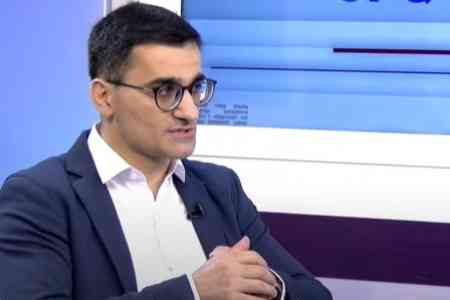
ArmInfo. The Nagorno-Karabakh conflict has shown that the role of small countries can be great, and in this sense Armenia has the ability to change the situation in the region. This opinion was expressed in an interview with ArmInfo by Caucasus expert Karen Igityan, who was previously banned from entering the country by the Armenian authorities, regarding the attempts of the Azerbaijani-Turkish tandem to obtain an extraterritorial corridor through Armenia's Syunik.
The expert is confident that the implementation of the Turkish-Azerbaijani project, which will connect Azerbaijan with Nakhichevan through the territory of Armenia, will change the entire configuration in the South Caucasus. "In particular, Turkey will gain direct access to Central Asia, which will sharply strengthen its position, and will be used against Russia and Iran. Armenia, in turn, will find itself isolated as a result of this step, since the only active border left will be with Georgia," he emphasized.
Igityan noted that this is the goal pursued by the Turkish-Azerbaijani tandem. According to the expert, both countries do not see Armenia on the Caucasus map in their long-term plans, and even if they do, then only as an enclave surrounded by Azerbaijan and Turkey on all sides. "If we want to understand what Azerbaijan and Turkey really want from Armenia, then we must pay attention to the demands that Turkey made in 1918 and 1920, as well as Azerbaijan in 1919, to our country. In both cases, we will notice that no transit role was envisaged for Armenia. In general, Armenia should either not be in the plans of Turkey and Azerbaijan, or it is a very small state that can be destroyed by them at any moment. For Azerbaijan, Armenia is simply the so-called "Western Azerbaijan," the Caucasus expert noted.
At the same time, he is sure that the Azerbaijani-Turkish tandem is already implementing this project. Igityan believes that Turkey and the United States are trying to get a corridor that is not controlled by Armenia or Russia in order to freely transfer military equipment to Central Asia in the future, as part of the planned confrontation.
"Moreover, the creation of a new conflict zone in Central Asia will be directed again against Russia. Accordingly, for the United States, the project allows the implementation of a long-term strategy to "contain" Russia and Iran, isolate them from each other, and create new hotbeds of tension, thanks to which large resources of these countries will be directed in the direction needed by the United States," the expert continued.
At the same time, Igityan is sure that the presence of an American private company on the territory of Armenia will represent the implementation of the same corridor, since it will essentially be a transfer of control over the road to the Americans, which will also weaken Armenia's position. "The transfer of control over an expensive private company raises a number of questions. For example, will this American company attract the participation of Turkish capital and will it be possible to track this in general? Will it be transferred later to some countries, for example, Turkey and so on. However, one thing is indisputable: the transfer of control over the route to the US will ultimately lead to the isolation of Armenia from Iran, as well as uncontrolled arms supplies to the Caucasus and Central Asia," the expert is sure.
"In Iran, this project is called the "NATO Turan corridor". Tehran understands well that if it is opened, and thus the alternative route through Armenia is lost, Turkey and Azerbaijan can either block all transport flows from Iran to the north, or raise transit prices so much that they will become unprofitable for Iran. Thus, Iran will lose its land connection with the north in the Caucasus direction. And if the implementation of the project also leads to a sharp increase in the role of Turkey, and NATO in general, in Central Asia, then Iran will also lose the opportunity to communicate with Russia along the Central Asian route. The same applies to Russia. The so-called "Zangezur corridor" will block Russia's access to the south along routes independent of NATO, at least by land," the Caucasus expert explained. In this vein, the expert noted that today the restraining factors for the implementation of this project are primarily the positions of Russia and Iran. The political scientist noted that Iran has concentrated quite large military forces in the north and constantly declares that opening the corridor and violating Armenia's sovereignty is unacceptable.
At the same time, he is sure that Russia's current busyness in Ukraine does not mean that it will not react to its opponents' attempts to seize this route.
"It is unlikely that Azerbaijan wants to face the Russian army, which, if the war with Ukraine ends, could move to the Caucasus. It should be noted that we are talking about a large army that has gone through heavy fighting and thus gained unique experience in waging a modern war," the expert noted.
At the same time, as Igityan noted, the extraterritorial corridor threatens the vital interests of Iran and Russia. In particular, according to him, for Iran the creation of such a corridor means the loss of the border with Armenia, as a result of which in the north Iran will actually border only with countries that are members of the Organization of Turkic States (OTG). According to him, this is why Iran will take all possible actions to prevent the "cutting" of a corridor on the ground.
At the same time, the expert does not see any opportunities for the implementation of the government project "Crossroads of the World", which, according to the Armenian authorities, fits into the global routes passing through the region and "will open up new opportunities for Armenia".
"Turkey and Azerbaijan have kept Armenia in isolation for decades and are not going to lift it. I do not see any opportunities for the implementation of the "Crossroads of Peace", since the countries that are supposed to open their borders and establish good neighborly relations within the framework of this project do not want this. We see this in the policies that, for example, Azerbaijan and Turkey are pursuing. Moreover, Azerbaijan is promoting the rhetoric on all platforms that Armenia is "Western Azerbaijan", where Azerbaijanis should live, with "security guarantees" and pre-agreed rights. Considering the intentions of the parties, I believe that this project cannot be implemented, moreover, no one will consider it as an alternative to the route that the Azerbaijani-Turkish tandem is trying to get hold of," Igityan is sure.
In addition, the expert noted that Armenia is already a transit country, and can continue to be so if it promotes, for example, the development of infrastructure within the framework of the North-South international transport corridor. Igityan assured that in this case, Armenia's transit role will only increase. "Armenia can really change a lot in the region, be it through finding new allies, rearming the army, preventing talks from a position of strength, for example, "either you give it up "voluntarily" or we take it by force." Armenia has prospects for pursuing a completely different policy in the future, moreover, these opportunities exist now. And in the future, with the right approach, there may be many more of them," the expert concluded.
Recall that the Meghri route is a project for a transport route about 40 km long through the territory of the Syunik region of Armenia, which would provide transport links between the western regions of Azerbaijan and its exclave, the Nakhichevan Autonomous Republic. The opening of transport routes in the region was envisaged by point 9 of the trilateral statement of November 9, 2020 by the leaders of Russia, Armenia and Azerbaijan. Meanwhile, Azerbaijan is trying to distort the essence of these agreements and get an extraterritorial corridor.


















 Political scientist: Real recount will deprive Pashinyan of any constitutional majority
 Expert: Even OSCE observers recorded numerous violations during elections in Armenia
  Armenia`s ex-minister of justice calls on opposition to honestly answer questions troubling Armenian citizens
 Lawyer: according to preliminary results, Pashinyan`s party lacks 2/3 majority necessary to amend Armenia`s Constitution
 Elections in Armenia were accompanied by unprecedented pressure on opposition, RF MFA spokesperson claims
  Moscow to await official results of Armenian elections - Peskov
 Antonio Costa: EU to deepen its partnership with Armenia, expanding cooperation in energy, trade, and digitalization
 Israeli MFA congratulates Pashinyan
 Turkish MFA comments on results of Armenian elections
  Zakharova: International observers cannot ignore `flagrant violations` in Armenian elections
 Strong Armenia to issue statement after vote count completed - Narek Karapetyan
 Russian Senator: Opposition complaints regarding election violations by ruling party remain unanswered
 RA premier receiving congratulations on his victory in parliamentary elections
 Head of IPA CIS Council Secretariat: Extremely difficult atmosphere during parliamentary elections campaign in Armenia accompanied by mass arrests
 Pashinyan`s party leads with 51.13% based on vote counts from 533 polling stations
 Voting in parliamentary elections in Armenia ends
  Strong Armenia: Administrative Court not providing judicial decisions to citizens wishing to vote in parliamentary elections