
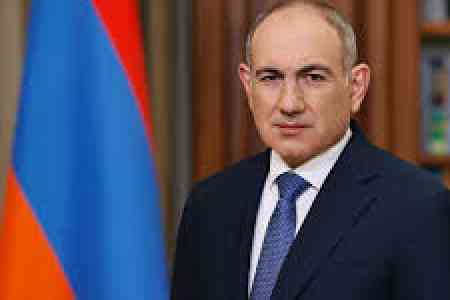
ArmInfo. The Armenian government has approved the Program for Adaptation to Climate Change in the Sphere of Water Resources for 2022-2026. A new draft law of the Republic of Armenia On Climate has been developed. The purpose of the draft law is to create a legal and institutional basis for the development and implementation of climate policy in the country. Prime Minister Nikol Pashinyan announced this while speaking at the International Environmental Conference in Gorno- Altaisk.
The Prime Minister recalled that Armenia is a mountainous country, 80% of whose territory is occupied by highland regions. The country is known for its diversity of climatic zones: from arid subtropical to alpine. Armenia is home to many endemic species of flora and fauna. Four national parks and three reserves occupy more than 10% of the country's territory. Among them is the Khosrov Reserve, created on the basis of an artificial forest founded in the 4th century as a royal hunting ground. The pearl of Armenia, Lake Sevan, is the largest freshwater reservoir in the region. The country's mountain ecosystems are extremely vulnerable to climate change, he emphasized. Droughts, floods and flash floods are becoming more frequent. Although Armenia's carbon dioxide emissions are extremely insignificant on a global scale, the country is among the countries most affected by global warming. The consequences of climate change are expressed in accelerated melting of glaciers, reduced precipitation, landslides, soil erosion and desertification. The lack of water resources leads to a decrease in the efficiency of pastures and arable lands, as well as a reduction in forest resources. In this context, we emphasize the importance of increasing water use efficiency, introducing innovative technologies and implementing drip irrigation programs.
In response to national needs and international commitments, in May 2021, the Government of the Republic of Armenia approved the National Action Plan for Adaptation to Climate Change and the List of Activities for 2021-2026, thereby defining the strategic framework for adaptation and planning measures for its implementation in the country on a permanent and continuous basis in the future. Armenia, he noted, welcomes the cooperation of the EAEU member states within the framework of the climate agenda, and Eurasian low-carbon development programs are also important.
As Pashinyan noted, Armenia, attaching great importance to the preservation of biodiversity, is implementing programs to restore wild animal populations. Since 2002, the program to restore the Caucasian leopard population, implemented jointly with the World Wildlife Fund, has yielded significant results. The permanent residence and reproduction of cubs of this species has already been recorded in Armenia, which indicates that the stability of the habitat and food supply of the Caucasian leopard has been achieved. The Fund is also implementing a program to restore the population of the Caucasian red deer in the Dilijan Nature Reserve.
"Armenia also supports the UN agenda for mountain countries. We actively participate in the work of the Group of Friends of Mountain Countries within the UN, initiated by Kyrgyzstan. We also joined the initiative of the Kyrgyz side within the Conference of the Parties to the UN Climate Change Convention. We hope that the group will become an active participant in the negotiation processes within the climate conference, for which we are ready to actively contribute to the formation of the necessary agenda within the group," he said.
he Armenian Prime Minister recalled that the 17th meeting of the Conference of the Parties to the Convention on Biological Diversity (COP17) will be held in Armenia in 2026.
"We look forward to the participation of high-level delegations from your countries, as well as representatives of academic and expert circles in the work of COP17.
As the chair and host country, Armenia will make every effort to ensure a productive dialogue, to bring the positions of the parties closer together and to make balanced and meaningful decisions that take into account the interests and priorities of all parties.
We are confident that together we will be able to make a significant contribution to global efforts to preserve biodiversity and rational use of natural resources, in the spirit of shared responsibility for our planet," Nikol Pashinyan summed up.
The International Environmental Conference is being held on July 25 in the Altai Republic in the resort town of Manzherok. Eight countries are participating in it: the Russian Federation, the Republic of Armenia, the Republic of Belarus, the Kyrgyz Republic, the Republic of Kazakhstan, the Republic of Tajikistan, the Republic of Uzbekistan and Turkmenistan. All states are long-standing partners and interact on environmental issues both bilaterally and within the framework of international associations.

























 Iranologist: Baku`s propaganda of might masks the country`s inability to provide water to its own population
 Analyst: Continued tensions between Yerevan and Moscow could entail new restrictive measures from Russia
 Political analyst: Russia intends to determine which "Camp" Armenia will choose through a referendum
 Armenia and France discuss further development of strategic partnership and EU cooperation
  To overcome risks Armenia must reduce domestic escalation - expert
  Zatulin: Pashinyan was eager to get back to Russia because he actually lost the elections
 Pashinyan removed from INNOPROM guest list
 Zakharova: Armenia`s pro-EU pivot poses economic security risks to EAEU member states
 It`s time for South Caucasus countries to think of South Caucasus as single, unified region - RA premier
  Pashinyan: Armenia and Azerbaijan should leave each other alone
 Moscow sees situation with Armenia as attempt to attack Russia-involving integration associations - Russian presidential aid
 Zakharova: Armenia views relations with Russia as tool for financially securing reorientation toward EU
 The Armenian Minister of Justice and the EU Ambassador discussed visa liberalization issues for Yerevan.
 Azerbaijan`s aggressive plans against Armenia became possible in wake of Pashinyan`s decisions on Artsakh - expert
  Zakharova: Russia sent a note of protest to Armenia over the act of vandalism at the "Mother Armenia" memorial in Gyumri