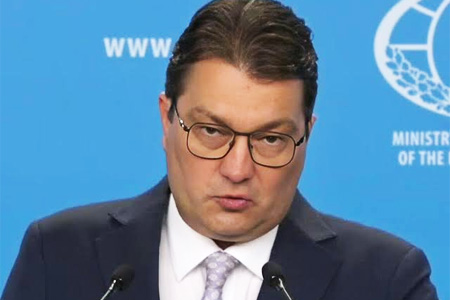
ArmInfo. The socio-economic consequences of the country's "jump" into Europe are being concealed from the Armenian people, and current export difficulties are being falsely portrayed as restrictions imposed by Moscow.
This was stated by Alexey Fadeev, Deputy Director of the Information and Press Department of the Russian Ministry of Foreign Affairs, during a press- briefing on August 6, in response to a request to comment on recent statements by high-ranking Armenian officials regarding Russian-Armenian relations.
He noted that the Russian side had seen them and believes that Yerevan, when making these statements, was engaged in some kind of speculation, the purpose of which is obvious. "It stems from an intention to shift responsibility to others. The emergence of problems with Russia and the EAEU is explained by the fact that Armenia was merely trying to find alternatives, both politically and economically. And of course, creating a multi-vector state is a task and priority for the political leadership of any country, but we shouldn't confuse the concepts. Because if we hide behind the beautiful word "diversification" a pivot away from Eurasian integration and a traditional ally toward the European Union (EU), which is openly hostile to Russia and which is even more so considering the possibility of a direct confrontation with the country, then the conclusion is obvious," Fadeyev clarified.
According to him, this is nothing more than outright deception, not only in relation to its Eurasian integration partners but also to its own population. "It's no wonder that the socioeconomic consequences of such a jump into Europe are being concealed from Armenian citizens, and current export difficulties are being presented as some kind of restrictions from Moscow. But we must understand that these are not our restrictions, but the reality that awaits the Republic if traditional ties are severed. We have repeatedly asked the Armenian leadership to speak honestly about all the pros and cons of such a reorientation toward the EU. Unfortunately, this has not been done and is still not being done," the Russian Foreign Ministry representative noted.
He believes that Yerevan is thus abandoning its exclusive relationship with Moscow, which allegedly hindered the search for alternative vectors. Instead, he says, the population is being offered a multitude of signed declarations on allied cooperation with Western countries. However, as Fadeyev noted, it is important to recognize that documents replete with catchy phrases are not legally binding. "And in practice, they lead to nothing, unlike the array of Russian-Armenian treaties and agreements. Neither Brussels, nor London, nor Paris will invest seriously in the Armenian economy. This is quite obvious. And we remember very well that back in 2024, Yerevan's freelance consultant, former NATO Secretary General Fogh Rasmussen, noted that the Republic is a low-cost enterprise for the West," the Russian Foreign Ministry representative noted.
In the context of Russian-Armenian relations, he noted that, instead of constructive dialogue, the Russian side is witnessing Yerevan's attempts to up the ante or resort to blackmail. This, Fadeyev explained, includes the persecution of pro-Russian figures and the threat of arbitration proceedings against Russian companies operating in Armenia, which are major taxpayers. "This also includes demands that Moscow pay billions of dollars for projects that the current authorities themselves, at the dawn of their political careers, refused to give up. Incidentally, before making such statements, it would be wise to familiarize themselves with the agreements and legal framework, which clearly spell out who owes whom and how much. This line raises doubts about the readiness of Armenia's ruling circles for genuine allied cooperation with Russia. And if Yerevan is seeking to ensure that its interests are taken into account, then why shouldn't Moscow make a similar reciprocal demand of its Armenian partners? For now, we see that the leadership perceives the prospects for our relations as a one-way street, and of course, we are hoping for a more balanced and realistic approach," the Russian Foreign Ministry representative concluded.















 Analyst: The primary issue with Armenia`s new Parliament Speaker`s speech lies is its one-sided interpretation of the causes of the political crisis
 Expert: Gagik Tsarukyan embodies post-Soviet model of big business-state relations; this model is used in many other post-Soviet countries
 Expert: Azerbaijan promoting aggressive plans against Armenia at state level
 Iranologist: Baku`s propaganda of might masks the country`s inability to provide water to its own population
 NA Vice Speaker candidate believes his wife`s salary as director of HayPost is the lowest in the company`s history
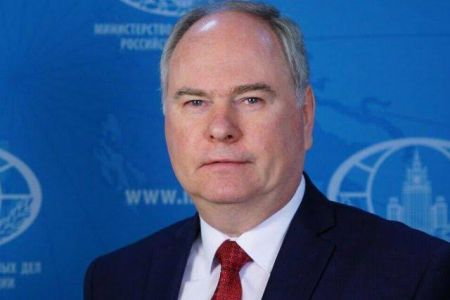 RF Permanent Representative: There is no CSTO-Armenia conflict
 Moscow: NATO seeking to "Pull" Armenia away from CSTO Allies
  Political analyst: Russia intends to determine which "Camp" Armenia will choose through a referendum
 Narek Karapetyan will give up his parliamentary salary in favor of charitable contributions.
 Armenia and France discuss further development of strategic partnership and EU cooperation
  To overcome risks Armenia must reduce domestic escalation - expert
  Zatulin: Pashinyan was eager to get back to Russia because he actually lost the elections
 Human rights activist Ruben Melikyan dismissed from YSU
 Zakharova: Armenia`s pro-EU pivot poses economic security risks to EAEU member states
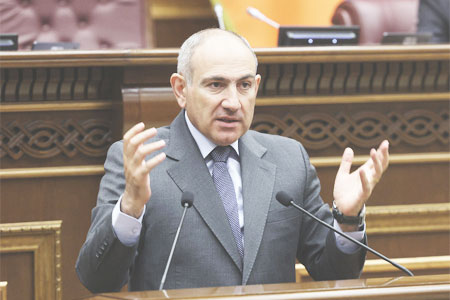 It`s time for South Caucasus countries to think of South Caucasus as single, unified region - RA premier
  Pashinyan: Armenia and Azerbaijan should leave each other alone
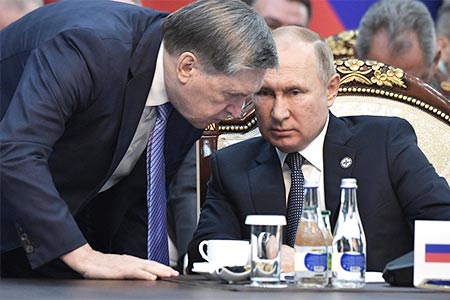 Moscow sees situation with Armenia as attempt to attack Russia-involving integration associations - Russian presidential aid