
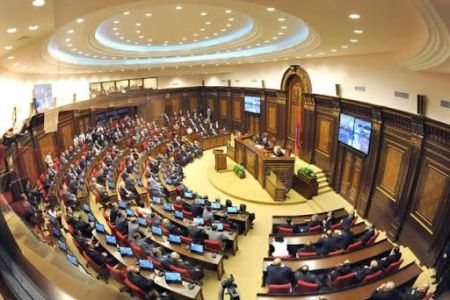
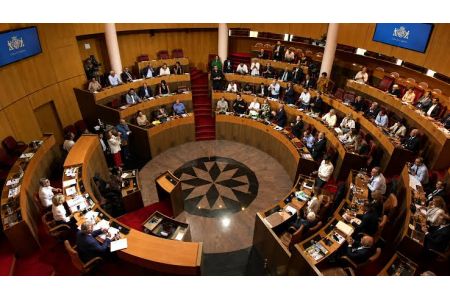
ArmInfo. The first session of the National Assembly of Armenia of the ninth convocation will take place on August 2 at 10:00 AM. It will be primarily devoted to the formation of the governing bodies of the new parliament.
Until the election of the parliamentary speaker, the session will be chaired by the oldest member of parliament, Knyaz Hasanov. The President of the Republic of Armenia and the Catholicos of All Armenians have the right to deliver a welcoming speech at the opening of the first session, but the Catholicos has not received an invitation to the first session of the new parliament. Following the welcoming speeches, the members will take the oath of office. The updated oath reads, in part: "In the name of the longevity, independence, sovereignty, and strengthening of the Republic of Armenia, I swear to conscientiously fulfill my duties as a representative of the people, to observe the Constitution and laws of the Republic of Armenia, to contribute to the strengthening of statehood and the protection of the interests of the Republic of Armenia, to do everything for the sake of civic solidarity, the security and well-being of the citizens of the Republic of Armenia, and the protection of human rights and freedoms. Glory to the fallen, and long live the Republic of Armenia!"
Following this, the presiding officer, based on the protocol of the Central Electoral Commission, will officially announce the total number of deputies of the new convocation, name the parties and blocs that have formed political coalitions, and introduce the parliamentarians by reading out the first and last name of each deputy and the name of the political party that nominated them. The deputies will then register. One of the first organizational issues will be the creation of a Counting Commission. Its composition will be formed based on the proposals of parliamentary factions and approved by a vote of deputies. Both the ruling party and the opposition factions will be represented on the commission, proportional to the number of their parliamentary mandates. The Counting Commission will organize votes in the National Assembly and tally the results of secret ballots. The commission's powers will remain in effect for the entire term of the ninth convocation of parliament.
After the Counting Commission is formed, deputies will proceed to elect the Speaker of the National Assembly. The ruling Civil Contract faction has nominated Ruben Rubinyan, who served as Vice Speaker in the 8th convocation of parliament, for this position. Three vice speakers will then be elected, two representing the ruling faction and one representing the Strong Armenia bloc. Civil Contract has already selected its candidates: Vahagn Aleksanyan and Hayk Konjoryan. Lawyer Aram Vardevanyan is likely to be Strong Armenia's candidate.
The agenda of the first session will also include the creation of parliamentary standing committees and the election of their chairs. Leadership positions in the committees will be distributed among parliamentary parties according to the D'Hondt formula—proportionate to the number of mandates they received. According to the official results, the Civil Contract party received 64 mandates, the Strong Armenia bloc 29, and the Armenia bloc 12. Accordingly, representatives of the Civil Contract party are expected to head nine standing committees, the Strong Armenia bloc- two, and the Armenia bloc- one. The Speaker of the National Assembly will also make a statement on the formation of parliamentary factions, standing committees, and the National Assembly Council.
If the government submits draft changes to the executive branch structure to parliament by August 2, the document may also be included in the agenda of the first session and considered. If no such draft is submitted, the session's agenda will be primarily limited to the formation of the governing bodies and standing committees of the new parliament.
According to constitutional procedure, the parliamentary faction with the majority of seats must decide on the candidate for prime minister and submit it to the President of the Republic. The President then appoints the prime minister. The appointed head of government must form a cabinet of ministers within five days. After the government is formed, the prime minister is required to submit a five-year government program to the National Assembly within 20 days. Parliament is required to review the document and approve or reject it by vote within seven days.


















 Iranologist: Baku`s propaganda of might masks the country`s inability to provide water to its own population
 Analyst: Continued tensions between Yerevan and Moscow could entail new restrictive measures from Russia
 Political analyst: Russia intends to determine which "Camp" Armenia will choose through a referendum
 Armenia and France discuss further development of strategic partnership and EU cooperation
  To overcome risks Armenia must reduce domestic escalation - expert
  Zatulin: Pashinyan was eager to get back to Russia because he actually lost the elections
 Human rights activist Ruben Melikyan dismissed from YSU
 Pashinyan removed from INNOPROM guest list
 Zakharova: Armenia`s pro-EU pivot poses economic security risks to EAEU member states
 It`s time for South Caucasus countries to think of South Caucasus as single, unified region - RA premier
  Pashinyan: Armenia and Azerbaijan should leave each other alone
 Moscow sees situation with Armenia as attempt to attack Russia-involving integration associations - Russian presidential aid
 Zakharova: Armenia views relations with Russia as tool for financially securing reorientation toward EU
 The Armenian Minister of Justice and the EU Ambassador discussed visa liberalization issues for Yerevan.
 Azerbaijan`s aggressive plans against Armenia became possible in wake of Pashinyan`s decisions on Artsakh - expert
  Zakharova: Russia sent a note of protest to Armenia over the act of vandalism at the "Mother Armenia" memorial in Gyumri