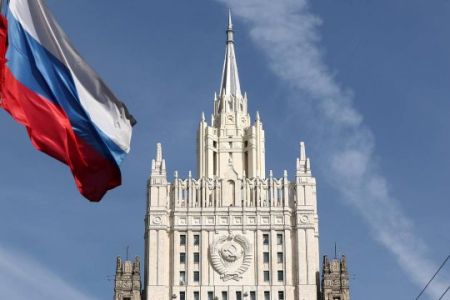
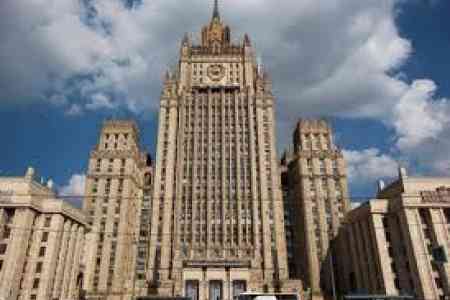
ArmInfo. The Russian Foreign Ministry responded to the so-called revelations by the Latvian publication The Insider, emphasizing that the arguments presented in the "investigation" are nothing more than blatant lies and an orchestrated provocation aimed at exerting psychological pressure on Russian diplomats and intimidating the Armenian public ahead of the elections.
The Russian Foreign Ministry's statement emphasized that "the foreign agent publication The Insider, which has long been a tool of media manipulation and false anti-Russian propaganda, continues to generate fakes, fulfilling the corresponding orders of its foreign handlers." The Russian Foreign Ministry added that an example of such subversive work by Western-controlled media outlets was a recent publication (dated May 19, 2026) under the headline "Grab by the Beard." Which FSB, GRU, and SVR agents were sent to Armenia to fight Pashinyan? This publication recounts the now-trendy "spy" tales about ubiquitous "Kremlin agents."
"The authors of this fake, who apparently so carefully studied the biographical details of the diplomatic mission's employees, didn't even bother to double-check the information, making numerous factual errors and inaccuracies, which only confirms the level of 'professionalism' and banal literacy of the authors. To support their arguments, they publish hardly credible 'screenshots' and 'extracts' from some documents, and randomly cite certain episodes from the lives of diplomats, which are considered 'tales' in their professional activities, with references to (!) 'anonymous' sources and foreign media outlets that have long been tainted by outright disinformation and anti-Russian bias.
At the same time, The Insider is unable to provide a single convincing fact to support the accusations of 'coordinating the campaign against Pashinyan' or 'manipulating election results,'" the Russian Foreign Ministry stated. Moscow added that a familiar pattern is being observed once again: the effective work of Russian agencies to develop and strengthen allied relations between Russia and Armenia, and the ties between our fraternal peoples, is being declared a "special services operation." The Russian Foreign Ministry added that completely routine diplomatic activities-maintaining contacts, hosting cultural events, analytical work, promoting humanitarian projects-are all being presented as if they were the "hand of the Kremlin."
"Equally concerning is the policy of discrediting the Armenian opposition and public figures who criticize the republic's leadership. Any contacts between such figures and the Russian side, or their participation in international forums and expert events, are automatically declared to be 'work under the supervision of Russian intelligence services,' and the opposition activity itself is considered part of a 'Kremlin operation.' In other words, they are trying to foist upon Armenian society the simplistic notion that 'government critics are equal to Moscow agents.' In essence, it is not Russia's diplomatic activity, which is conducted in full compliance with the 1961 Vienna Convention on Diplomatic Relations, that directly interferes in Armenia's election discourse, but the fact that The Insider's latest piece of information is fueling hysteria in the Armenian and international information space," Moscow added.
At the same time, the Russian Foreign Ministry expressed its conviction that, against the backdrop of such "investigations," it becomes clear where the European funds allocated under the specious pretext of "supporting democracy" and "facilitating fair elections" in Armenia are actually going. Moscow noted that, judging by the content and focus of publications like The Insider's, a significant portion of these funds ends up in the pockets of biased media outlets and organizations engaged in promoting an anti-Russian agenda rather than genuinely strengthening democratic institutions.
"Apparently, the fake news spread in the Armenian media is the result of consistent anti- Russian subversive work by Brussels-based propagandists from the so-called rapid response group, which had recently landed in the Republic with the aim of discrediting our country and damaging Russian-Armenian relations under the pretext of allegedly combating the Kremlin's 'hybrid threats.' This is a clear projection of the 'Moldovan scenario' onto Armenia-creating a hostile, toxic atmosphere around Russia and purging the local information space of anything related to our country. We have repeatedly warned our Armenian partners of the consequences and risks. One of these is the direct loss of sovereignty," the Russian Foreign Ministry added. Moscow believes that what is happening in Armenia's information space today, including such fake news, largely follows established patterns of demonizing any forces advocating for maintaining and developing cooperation with Russia.
The Russian Foreign Ministry recalled that The Insider has been designated a foreign agent and an undesirable organization in Russia for its subversive nature and threat to the foundations of the constitutional order. "In this context, we view the latest 'sensation' about 'Russian agents in Yerevan' as yet another episode in the campaign to oust Russia from the South Caucasus and impose external guidelines on Armenia contrary to its own national interests. It was all the more surprising to hear immediate assessments from certain members of Armenia's top leadership, who referred to the publication as an 'influential Russian resource' and categorically embraced the anti-Russian narrative being promoted as the 'ultimate truth.' We are confident that the Armenian people will not be deceived," the Russian Foreign Ministry concluded.











 Expert: Current process is not about peace, but implementing Azerbaijan`s wishlist
 Expert: Real peace unattainable until Armenia-Azerbaijan agreement is signed and ratified
 TRIPP`s proximity to Iranian border could slow its implementation - expert
  Who and why is sacrificing RA National Security Service`s reputation? - expert
  Tehran creating security environment in which sustainable shipping in Strait of Hormuz difficult to imagine without its direct participation - expert
  Arrested Armenian oligarch on economy and new jobs
  NA Vice Speaker candidate believes his wife`s salary as director of HayPost is the lowest in the company`s history
 RF Permanent Representative: There is no CSTO-Armenia conflict
 Moscow: NATO seeking to "Pull" Armenia away from CSTO Allies
  Political analyst: Russia intends to determine which "Camp" Armenia will choose through a referendum
 Narek Karapetyan will give up his parliamentary salary in favor of charitable contributions.
 Armenian analyst: Developing relations with Europe and the U.S. must not jeopardize relations with regional powers
 Armenia and France discuss further development of strategic partnership and EU cooperation
  To overcome risks Armenia must reduce domestic escalation - expert
  Zatulin: Pashinyan was eager to get back to Russia because he actually lost the elections
 Human rights activist Ruben Melikyan dismissed from YSU
 Pashinyan removed from INNOPROM guest list
 Zakharova: Armenia`s pro-EU pivot poses economic security risks to EAEU member states
 It`s time for South Caucasus countries to think of South Caucasus as single, unified region - RA premier
  Pashinyan: Armenia and Azerbaijan should leave each other alone