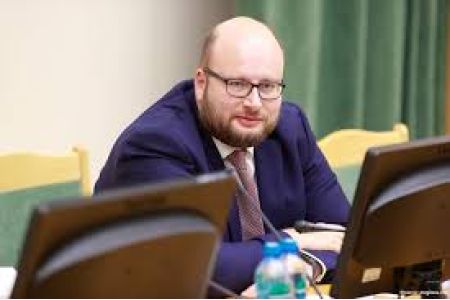
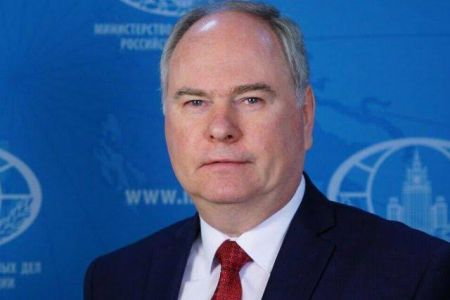
ArmInfo. Russia remains interested in continuing contacts in the "3+3" format on the South Caucasus and hopes for the platform's full operation to resume as soon as possible. Mikhail Kalugin, Director of the Fourth Department of the CIS Countries at the Russian Foreign Ministry, stated this in an interview with TASS.
He noted that the "3+3" format, which includes Azerbaijan, Armenia, Georgia, Russia, Iran, and Turkey, serves as "an important tool for establishing cooperation between the South Caucasus states and their immediate neighbors based on the principle of 'regional responsibility.'" At the same time, Kalugin noted that for a number of objective reasons, one of which is the situation surrounding Iran, there has been "some pause" in organizing the next ministerial meeting in the "3+3" format.
"However, interest in continuing contacts remains. We look forward to the platform's full-fledged operation as soon as possible," emphasized the director of the fourth CIS department.
The diplomat clarified that the principle of regional responsibility lies in coordinating "mutually beneficial and promising projects that meet the interests of all regional players; decisions are made without external pressure, without an 'agenda' imposed by outside forces."
"The point is to avoid creating dividing lines and not to work to the detriment of any country in the region." "Only on this basis can we truly ensure security and economic prosperity, as well as genuine and lasting peace in the South Caucasus," he explained.
Kalugin also recalled that the founding meeting of the "3+3" platform took place in Moscow in December 2021, with Azerbaijan and Turkey initiating the format. "In October 2023, the foreign ministers held a joint meeting in Tehran." "At the ministerial meeting in Istanbul in October 2024, an agreement was reached to begin discussing specific issues of cooperation in the areas of transport, energy, and culture," he continued.
In this regard, the Director of the Fourth Department of the CIS countries noted that active preparations are currently underway to launch an expert "track" for "discussing key and problematic issues in the activities of the 'three plus three' with the participation of leading political scientists from participating countries, including Georgia."
Speaking generally about the South Caucasus, he recalled that Russia is a Caucasian power and is closely linked to processes in the region, making the South Caucasus vitally important to it.
"Our interests stem from the fact that Russia is not just a neighbor, but is itself a Caucasian power. We have the closest historical and cultural ties with all the states in the region. We have established allied relations with four of the five republics. For each of the South Caucasus countries, Russia is the main or one of the main trading partners. Significant transport arteries for us pass through the region. The state of affairs in the North Caucasus largely depends on how events unfold on the other side of the ridge. In short, the South Caucasus is vitally important to us," the diplomat said.
According to him, Russia's fundamental interest lies in developing the region, unlocking its economic potential, and creating a "belt of stability and peace" there. "What contributes to the region's prosperity also contributes to Russia's well-being. This is the simple logic of our actions. Following this logic, we consistently oppose armed conflicts in the region, support the lifting of blockades, and vigorously work to build a common architecture of regional connectivity so that each country can take advantage of its geographical location. We want the economy of the South Caucasus to breathe freely. This is beneficial for us," Kalugin emphasized.
"That is precisely why, in 2020, Russian President Vladimir Putin made personal efforts to end the bloodshed between Azerbaijan and Armenia. The foundations of the peace process between Baku and Yerevan were also laid at that time. The process has already gone through several phases, but it remains consistent with the roadmap developed based on the agreements reached by the leaders of Russia, Azerbaijan, and Armenia in 2020-2022," the Foreign Ministry department director stated.














 Expert: Gagik Tsarukyan embodies post-Soviet model of big business-state relations; this model is used in many other post-Soviet countries
 Expert: Azerbaijan promoting aggressive plans against Armenia at state level
 Iranologist: Baku`s propaganda of might masks the country`s inability to provide water to its own population
 Moscow: NATO seeking to "Pull" Armenia away from CSTO Allies
  Political analyst: Russia intends to determine which "Camp" Armenia will choose through a referendum
 Narek Karapetyan will give up his parliamentary salary in favor of charitable contributions.
 Armenia and France discuss further development of strategic partnership and EU cooperation
  To overcome risks Armenia must reduce domestic escalation - expert
  Zatulin: Pashinyan was eager to get back to Russia because he actually lost the elections
 Human rights activist Ruben Melikyan dismissed from YSU
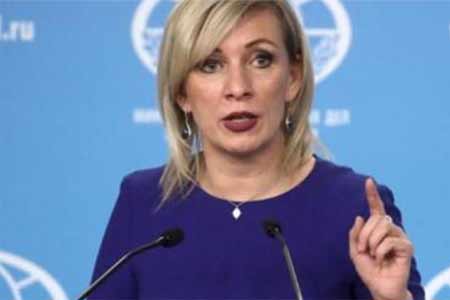 Zakharova: Armenia`s pro-EU pivot poses economic security risks to EAEU member states
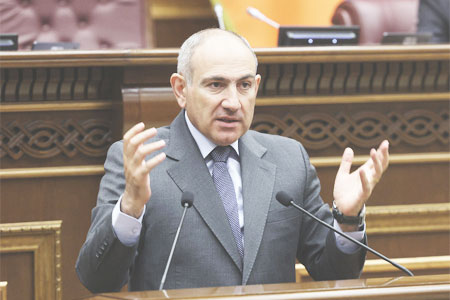 It`s time for South Caucasus countries to think of South Caucasus as single, unified region - RA premier
  Pashinyan: Armenia and Azerbaijan should leave each other alone
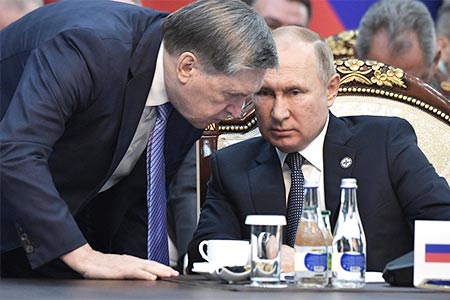 Moscow sees situation with Armenia as attempt to attack Russia-involving integration associations - Russian presidential aid
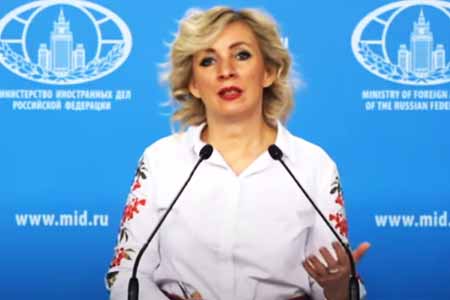 Zakharova: Armenia views relations with Russia as tool for financially securing reorientation toward EU