

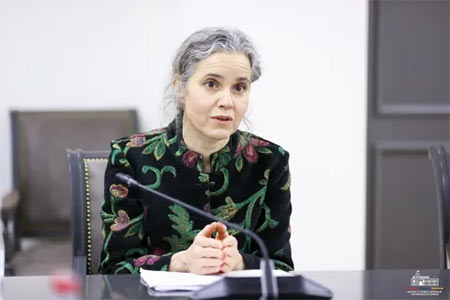
ArmInfo.The South Caucasus is an important link between Europe and Central Asia. This became possible thanks to the unprecedented momentum that emerged after the Washington summit in August 2025, which opens up new strategic opportunities for the region, as stated by Magdalena Grono, EU Special Representative for the South Caucasus and the Crisis in Georgia, during the Yerevan Dialogue 2026 Forum on May 5.
According to her, it also opens up new opportunities for closer cooperation with the Middle East. Grono believes that the South Caucasus is important today as an island of stability amid two major theaters of military operations. "The Middle Corridor project is currently being widely discussed. According to our calculations, traffic volumes along the Central Corridor have quadrupled since 2022, and we hope that they can triple again by 2030. These are the kinds of investments we are discussing with our partners in the South Caucasus," the EU Special Representative said.
At the same time, she expressed confidence that connectivity should be inclusive and not isolate any of the partners in the region. She added that, based on this, the EU is discussing transport infrastructure development projects with its colleagues in Yerevan and Baku.
"The peace process between Armenia and Azerbaijan was truly an incredibly powerful process, in which external players may have provided important assistance, but ultimately, I believe, the decisive responsibility was the responsibility of the two capitals. And in this regard, we truly would like to be simply partners in the sense that the agenda is clearly defined by regional players, and we support this where it is useful and necessary," she added.
Stefano Piedimonte Bodini, Director of the Private Office of the Secretary General of the Council of Europe, stated that Europe needs military security, energy security, and economic security, and this particularly applies to the South Caucasus, in conjunction with democratic security, robust institutions, and the rule of law.
According to him, this is precisely the work Armenia and the Council of Europe have been working together for 25 years. "The Council of Europe's support for Armenia is long-term; it is a long-term commitment. It is about helping institutions that counter the hybrid pressures that Armenia also faces from cybercrime to malicious information manipulation and foreign interference.
Europe must say 'no' to manipulation in elections and the media, especially on social media, while protecting freedom of speech, independent media, human rights, and the rule of law," he emphasized. He added that powerful armies without strong democratic institutions and robust democratic oversight are dangerous.












 Political scientist: Real recount will deprive Pashinyan of any constitutional majority
 Expert: Even OSCE observers recorded numerous violations during elections in Armenia
  Armenia`s ex-minister of justice calls on opposition to honestly answer questions troubling Armenian citizens
 Elections in Armenia were accompanied by unprecedented pressure on opposition, RF MFA spokesperson claims
  Moscow to await official results of Armenian elections - Peskov
 Antonio Costa: EU to deepen its partnership with Armenia, expanding cooperation in energy, trade, and digitalization
 Israeli MFA congratulates Pashinyan
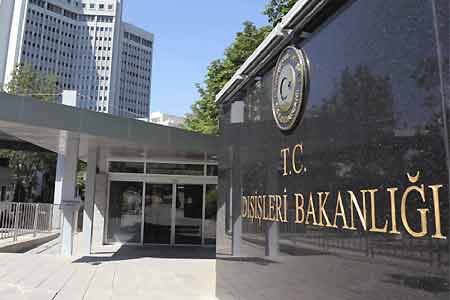 Turkish MFA comments on results of Armenian elections
 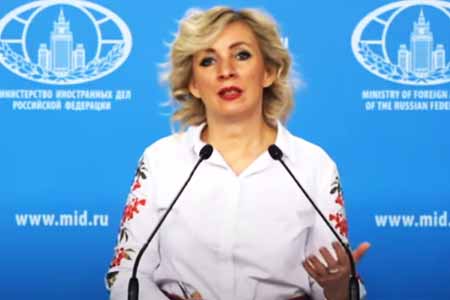 Zakharova: International observers cannot ignore `flagrant violations` in Armenian elections
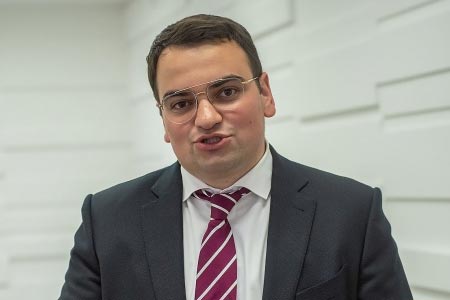 Strong Armenia to issue statement after vote count completed - Narek Karapetyan
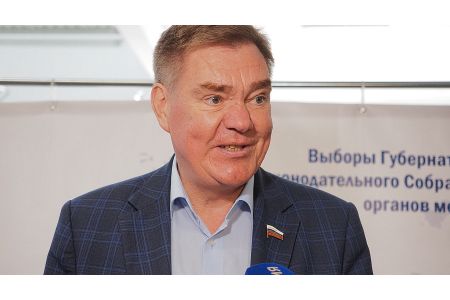 Russian Senator: Opposition complaints regarding election violations by ruling party remain unanswered
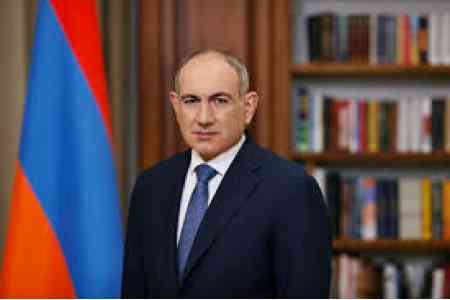 RA premier receiving congratulations on his victory in parliamentary elections
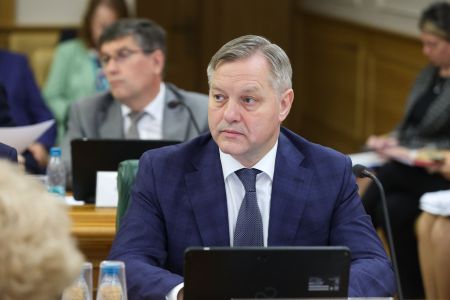 Head of IPA CIS Council Secretariat: Extremely difficult atmosphere during parliamentary elections campaign in Armenia accompanied by mass arrests
 Pashinyan`s party leads with 51.13% based on vote counts from 533 polling stations
 Voting in parliamentary elections in Armenia ends
 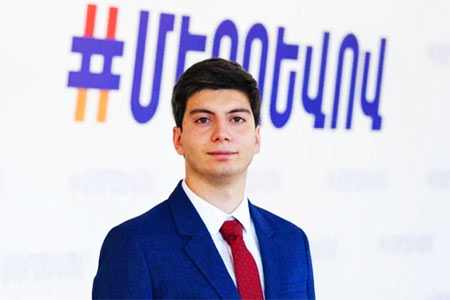 Strong Armenia: Administrative Court not providing judicial decisions to citizens wishing to vote in parliamentary elections