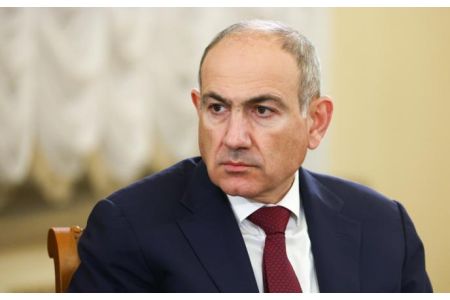
ArmInfo. RA Prime Minister Nikol Pashinyan held a working discussion with RA Interior Minister Arpine Sargsyan, during which they presented progress on introducing a new system of biometric passports and ID cards in Armenia.
According to the government press service, during the discussion, the Prime Minister noted that the process of introducing biometric passports and ID cards is in the final stages and will be available to citizens starting in the fall of 2026.
Arpine Sargsyan, in turn, emphasized that the goal of introducing the new system is to ensure that identity documents comply with high international standards, in particular, the requirements of the International Civil Aviation Organization (ICAO). According to the Minister, this will enhance the security of documents, simplify border crossings, and facilitate the free movement of citizens, including through the process of visa liberalization with the European Union.
The Minister of Internal Affairs noted that modern infrastructure is also being created as part of the implementation of the new system. The project is being implemented as a public-private partnership. The new passports will be equipped with high-level security features, including security components and ultraviolet layers. It was also emphasized that the document's design reflects Armenian identity, historical and cultural heritage, and symbols of statehood. Accordingly, the design primarily features the outline map of the Republic of Armenia, the alphabet created by Mesrop Mashtots, and the phrase: "To recognize wisdom and guidance, to know the words of genius."
The Prime Minister noted that some letters are larger, which suggests a certain thought and logic behind this.
"Specifically, the letter 'A' signifies freedom and independence, the letter 'Y' signifies happiness, the letter 'E' signifies God, emphasizing the role of God, the letter 'Zh' signifies people, the letter 'I' signifies sovereignty, the letter 'K' signifies life, 'N' signifies Armenia, 'M' signifies man, and 'J' signifies water. We also wanted to emphasize the letter 'O' as a symbol of life, as the original version did not include the letter 'O', implying legality. The letter 'P' signifies the state, the letter 'S' signifies love, and the letter 'K' signifies Christ, as the first nation to adopt Christianity. Of course, similar emphasis could have been placed on all the letters, but overall, we believed that such an emphasis would perhaps highlight our strategies, visions, aspirations, and ideas, as well as add a certain element to the design," the head of the Armenian government said.
Continuing to present the images located on various pages of the document, it was noted that it begins with the genealogy of Armenians, with an image of Hayk Nahapet and petroglyphs discovered in the Geghama and Ukhtasar mountains, which have a rather ancient history. The next important milestone in history is also presented-the cuneiform inscription on the founding of Yerevan, which is a very important part of Armenian identity and history. It was emphasized that the image of the Erebuni fortress was restored by scholars. Next, stones from the period of Artaxerxes are presented, bearing Aramaic inscriptions. The shape and position of the stones were also determined through consultation with scholars; they represent the lifestyle and agriculture of that period. It was emphasized that the choice of the stone was not random; it was a very important state and legal instrument even in that period, as it demonstrated the existence of the state, the essence of public administration, and the land reforms that were carried out during that period. The following page presents the Mother See of Etchmiadzin, symbolizing the adoption of Christianity as the state religion in 301. The year of the adoption of Christianity is emphasized as a key component of Armenian identity and history.
In accordance with the logic of ceremonial precedence, symbols of modern statehood are represented: the residences of the president, government, National Assembly, and Constitutional Court. The Yerevan Cascade and Alexander Tamanyan, the patriarch of modern urban development, are also depicted.
The documents also make reference to the regions. The following regions are presented in alphabetical order: the Aragats region with its four peaks; the Ararat region with Khor Virap, one of the most important centers of Christianity; the Armavir region with its lavash-baking process; the Armavir region with its gardens and orchards; the Gegharkunik region with Lake Sevan and the 10th-century Berdkunk Fortress; the Kotayk region with the pagan temple of Garni; the Lori region with the Lori-Berd Fortress; the Shirak region with its historic center street and the famous view of Phaeton; the Syunik region with the Baghaberd Fortress; the Tavush region with its bridge; and the Vayots Dzor region with the Jermuk Waterfall and the famous deer, the symbol of Jermuk. The Prime Minister emphasized that through all these historical and cultural monuments, an attempt was made to ensure the diversity and multifaceted portrait of Armenia. It was emphasized that, in parallel with the introduction of biometric passports, automated contactless border crossing systems are also planned for border crossings, which will significantly simplify and expedite citizen travel.
Summarizing the discussions, the head of state noted that with this move, Armenia is taking an important step toward creating a modern, secure passport system that meets international standards.
















 Opinion: Following Berlin talks, Baku gains expanded influence within EU and strengthens cooperation ties with main European powerhouse
 Armenian expert: Could modern Azerbaijan even exist without Russian and Soviet modernization?
 Zatulin: Pashinyan was eager to get back to Russia because he actually lost the elections
 Human rights activist Ruben Melikyan dismissed from YSU
 Pashinyan removed from INNOPROM guest list
 Zakharova: Armenia`s pro-EU pivot poses economic security risks to EAEU member states
 It`s time for South Caucasus countries to think of South Caucasus as single, unified region - RA premier
  Pashinyan: Armenia and Azerbaijan should leave each other alone
 Moscow sees situation with Armenia as attempt to attack Russia-involving integration associations - Russian presidential aid
 Zakharova: Armenia views relations with Russia as tool for financially securing reorientation toward EU
 The Armenian Minister of Justice and the EU Ambassador discussed visa liberalization issues for Yerevan.
 Azerbaijan`s aggressive plans against Armenia became possible in wake of Pashinyan`s decisions on Artsakh - expert
  Zakharova: Russia sent a note of protest to Armenia over the act of vandalism at the "Mother Armenia" memorial in Gyumri
 Samvel Karapetyan proposes creating a post-election opposition coalition